Manufacturing Sector
Traditional Industries
Traditional industries in Kerala include coir, handloom, cashew, khadi and village industries, and handicrafts. These industries generate large scale employment, especially for women from relatively marginalised sections. They remain closely linked to the natural resources of the State, although input supply chains have changed over time. Traditional industries create value and represent an important part of Kerala's heritage and culture. They play a significant role in promoting inclusive development.
The coir industry is among the earliest industries to have developed in Kerala. The industry is now mainly concentrated in Alappuzha district and provides employment to nearly 1 lakh workers, of whom about 80 per cent are women. The handloom industry is concentrated in Thiruvananthapuram and Kannur districts and in parts of Kozhikode, Palakkad, Thrissur, Ernakulam, Kollam, and Kasaragod districts. Major handloom products include dhotis, furnishings, sheets, shirting, saris, and lungis. The cashew industry is a major traditional agro-based industry in Kerala, with several processing units located in Kollam district, which is known as the cashew capital of the world. The khadi sector in Kerala has a strong base because of historical importance and social and political support. There are 29 khadi institutions engaged in khadi production and sales, including the Khadi and Village Industries Board, 14 board aided institutions, and 14 institutions aided by the Khadi and Village Industries Commission. Kerala also has a long tradition of handicraft production using materials such as ivory, bamboo, palm leaves, seashells, wood, coconut shells, clay, cloth, coir, metals, stone, and lacquer. Many traditional handicrafts are preserved in palaces, heritage homes, and museums across the State.
Handicraft sector
The Handicrafts Sector plays vital role in economic development in terms of its contribution to GSVA, providing employment to a vast segment of craft persons in rural and semi urban areas, and generation of foreign exchange. About 70 lakh craft persons who are the backbone of Indian Handicraft Industry possess inherent skill, technique, traditional craftsmanship. The Handicraft sector has experienced significant growth in terms of exports facilitated by various Government schemes. The export of handicrafts during the year 2024-25 [Upto December, 2024] is Rs 24595.97crore(Annual Report 2024-25, Ministry of Textiles, Government of India). The Government of India has initiated an integrated approach for promotion and development of the handicrafts sector under National Handicraft Development Programme (NHDP) and Comprehensive Handicrafts Cluster Development Scheme (CHCDS)
Handicraft industry in Kerala
Kerala has a rich tradition of handicrafts with variety of materials including ivory, bamboo, palm leaves, seashells, wood, coconut shells, clay, cloth, coir, metals, stone, lacquer ware, and more. Kerala has 32 unique crafts like ivory carving, wood and horn carving, bell metal casting, hand embroidery, and coconut shell carving, which are commercially important. Kerala State Handicrafts Apex Co-operative Society (SURABHI), Handicrafts Development Corporation of Kerala (HDCK), and Kerala Artisans Development Corporation (KADCO) are entrusted with the promotion of handicraft industry in Kerala.
Kerala State Handicrafts Apex Co-operative Society (SURABHI)
Surabhi, an apex organisation of primary handicrafts co-operatives, aims at uplifting the artisans by marketing their products and supporting them through welfare schemes of Government of Kerala and Government of India. There are 38 Co-operative societies and 8 showrooms under Surabhi inside and outside the State. It also operates a craft development centre and a common facility centre at Ernakulam. In 2024-25, Co-operative societies generated revenue of Rs 44.80 lakh and total employment generated was 25,000. A loss of agency reduced from Rs 100.96 in 2023-24 to Rs 46 lakh in 2024-25. Details are given in Appendix 4.6.1
Handicrafts Development Corporation of Kerala (HDCK)
HDCK, Government-supported organisation is specialised in procurement and marketing of handicraft products. Its main objective is to assure fair returns to artisans. HDCK has showrooms across Kerala including Sree Moolam Shashtyabdapurthi Memorial Institute (SMSMI) in Thiruvananthapuram and 19 Kairali emporia outlets spread within and outside the State. In addition, HDCK supports artisans through welfare schemes of Government of India and Government of Kerala. It finances schemes under National Backward Classes Finance and Development Corporation (NBCFDC) loan schemes. With the support of Government of India, the Corporation implements welfare schemes for artisans, conducts training programmes, set up Common Facility Centres, distributes tool kits, conducts exhibitions/craft bazars at important places and tourist centres and provides marketing facilities to the crafts produced by artisans.
In 2024-25, Corporation has earned Rs 906.30 lakh from sales, registering an increase of Rs 50.20 lakh over previous year. A total of 68 persons were employed in 2024-25 in the sale of handicraft products in HDCK. Details are given in Appendix 4.6.2.
The Kerala Artisans Development Corporation (KADCO)
KADCO, a Government-owned company established in 1981, is registered under the Companies Act, 1956. Corporation aims to uplift the indigenous artisans of Kerala, including carpenters, goldsmiths, blacksmiths, potters, masons, and those who work with copper/bronze and other handicrafts. To promote crafts, there are Common Facility Center's for Carpentry in Mini Industrial Estate at Nadavannur, Kozhikode, and Umayanallore, Kollam are functioning. In an effort to facilitate and empower the beneficiaries for their livelihood, KADCO introduced a registration-based online labour data bank. The data bank will aid in understanding and utilising hidden capabilities, providing proper training in respective domains, as well as in general aspects of doing business and commercial activities. This approach is the first step towards organising the beneficiaries and to ensure that they receive the support that is needed for their success.
As per the data for 2024-25 of KADCO, the total number of persons employed is 1.82 lakh while the turnover is Rs.5222.3 lakh. It has reported a profit of 92.1 lakh. Details are given in Appendix 4.6.3
Bamboo Industry
Bamboo is considered as sustainable, eco-friendly and renewable natural resource having special properties conducive in creating a wide range of everyday products. About 28 species of Bamboo are found in Kerala. Bamboo from Kerala forests is being supplied mainly to the pulp and rayon units at concessional rates. A unique feature of Kerala bamboo sector is that 67.3 per cent of the extracted bamboo comes from home gardens rather than from the forests
The Kerala State Bamboo Mission
Kerala State Bamboo Mission (KSBM), the bamboo development agency was constituted in 2003 under the Department of Industries and Commerce. KSBM implements the Centrally Sponsored National Bamboo Mission Scheme under Ministry of Agriculture and Farmers' Welfare, Government of India and functions at Kerala Bureau of Industrial Promotion (K-BIP) with the broad aim of marshalling the scattered resources of the State and adopting a focused approach to revitalise the bamboo sector by promoting value addition, enhancing income generation of workers in the sector, and alleviating poverty. The interventions initiated by KSBM through K-BIP include propagation and promotion of Bamboo-based entrepreneurship by providing necessary support services, creation of new design for innovative products in Bamboo sector, quality enhancement and product improvement on existing products through engineering inputs and providing necessary support to create market demands. The major activities undertaken by KSBM in the FY 2024-25 include (Source: K-BIP)
- As part of capacity building programmes, KSBM conducted 5 skill upgradation training programmes on Bamboo Handicrafts through NGOs/Societies/Bamboo Groups in Thrissur, Malapppuram, Pathanamthitta, Wayanad and Palakkad under National Bamboo Mission Scheme.
- A Bamboo Livelihood Business Incubation Centre was established by Kerala State Bamboo Corporation (KSBC) at Kothamangalam in Ernakulam with the financial assistance under the National Bamboo Mission Scheme with an objective to facilitate the livelihood support to the economically and socially backward community. One entrepreneur has started functioning in the centre.
- Kerala State Bamboo Mission facilitated the participation of Artisans/ Craftsmen from Kerala for exhibiting their Bamboo products in Kerala Pavilion of India International Trade Fair 2024 held at Pragati Maidan, New Delhi from November 14 to 27, 2024
- A Bamboo Museum and Handicrafts Centre was established on 28 November 2024at the campus of Jawaharlal Nehru Tropical Botanic Garden & Research Institute (JN TBGRI), Palode, Thiruvananthapuram.
- Kerala State Bamboo Mission organized the 21st edition of the Annual Mega Event 'Kerala Bamboo Fest' as a marketing support to the stakeholders in a larger scale, facilitating the participation of 281 Bamboo Artisans/ Craftsmen from 12 States.
- Registration of Bamboo Artisans of Kerala: In order to create a database of Artisans/ Craftsmen in Kerala engaged in this unorganized Bamboo Sector in the State, a Registration procedure has been introduced by Kerala State Bamboo Mission. The registered Artisans are provided an ID card by KSBM. So far 400 Artisans/ Craftsmen have been registered in this program.
- Kerala State Bamboo Mission facilitated the participation of Bamboo Artisans/ Craftsmen/NGOs in Invest Kerala Global Summit (IKGS) 2025 held at Grand Hyatt, Bolgatty, Kochi from February 21 to 22, 2025
- Kerala State Bamboo Mission participated in the 'Vividhhta Ka Amrit Mahotsav 2025' oganised at Rashtrapati Bhavan, New Delhi from March 6 to 9, 2025.
- The National Bamboo Mission (NBM), Ministry of Agriculture & Farmers Welfare, Government of India has approved the Annual Action Plan 2025-26 of Kerala for an amount of Rs.936.62 lakh with Central share of Rs.562.15 lakh and State share of Rs.374.77 lakh.
21st edition of Kerala State Bamboo Fest
Kerala Bamboo Fest is one of the major interventions undertaken by Kerala State Bamboo Mission (KSBM) for the development of marketing of Bamboo sector. It provides a platform for the beneficiaries to widen their market, acquire knowledge about product development and sharing information to each other. The first edition of the 'Kerala Bamboo Fest' was organized in 2004 at the Town Hall in Kochi. It also provides an opportunity and a platform for Bamboo Artisans from the State to interact and share knowledge with the Artisans from all over the Country. The 21st edition of 'Kerala Bamboo Fest' organised by the Department of Industries & Commerce, Government of Kerala in association with Kerala State Bamboo Mission (KSBM) and Kerala Bureau of Industrial Promotion (KBIP) was held at Marine Drive Ground in Ernakulam, from December 7 to 12, 2024. A total of 375 artisans/ craftsmen/ NGOs from within and outside the state displayed their products in the Fest.
The Kerala State Bamboo Corporation
The Kerala State Bamboo Corporation is an undertaking established in 1971 for the welfare, development and uplift of traditional bamboo workers in Kerala. The main objectives of the Corporation are to develop and promote industries based on bamboo, reed, cane and rattan; to undertake the manufacturing and trading of bamboo-based products, and to provide financial, technical and other assistance to the traditional bamboo workers.
The main activities of the corporation include collection of good quality reeds from government forests, distribution of these reeds to traditional bamboo weavers at a subsidised rate on a credit basis, as well as procurement of woven mats from the weavers. The main products of the corporation are bamboo mats, bamboo ply, flattened bamboo boards, bamboo flooring tile, bamboo furniture and handicraft items. As part of encouraging more workers into mat weaving, Kerala State Bamboo Corporation has started training programmes in making bamboo mats and handicraft items.
Kerala State Bamboo Corporation Ltd. has three feeder/primary processing units at Palakkad, Mananthavady and Nadapuram for converting raw bamboo into strips of different thickness. They are weaved to bamboo curtains for the production of Flattened Bamboo Board. The waste bamboo from processing, ranging from 50 per cent to 70 per cent, is further used to manufacture value added products like toothpick, curtain blinds, bamboo curtains and incense sticks. The agency under took activities for cutting reed from October 2024 and collected about 2370 bundles (47,400 number) of reed.
In 2025 production was under taken at Perumbavoor Plywood Manufactures Consortium Pvt Limited Common Facility Centre and a total of 2920 plywood board was produced. Total production in 2025-26 is 2985 boards with a total value of Rs.42.64 lakh. In 2025 (January to September) an amount of Rs 14.17 lakh has been provided as DA to bamboo mat weavers and reed cutters.
Problems and issues in the sector
Many traditional artisans in Kerala suffer from social and economic disadvantages, making it difficult for them to sustain in the industry. Limited entrepreneurship, insufficient skill development programmes and lack of modernisation in designs and products are the major challenges faced by the sector. The handicraft industry is labour-intensive, and artisans face difficulties in terms of hands-on labour. Lack of interest of new generation to enter this field is a major challenge faced by the handicraft sector. Industries dependent on bamboo and other raw materials face unique challenges like absence of proper supply chain impacting the overall sector. Artisans struggle to access markets, making it challenging to sell their products. Insufficient financial support and resources, like shortage of working capital and credit facilities hinder the growth of artisans and the sector as a whole. The handicraft sector faces stiff competition from machine-made products, affecting demand and pricing. Lack of awareness about technology, designs and developing tools, standardisation and packaging, lack of effective pricing mechanism, exploitation by intermediaries and availability of cheap replacements for the crafts are also the challenges prevailing in the sector. Due to adverse working conditions, craftsmen are reluctant to pursue traditional employment, which results in a shortage of skilled workers in industries like bamboo.
Way Forward
To tackle the challenges, collaboration among the Government and various stakeholders is essential to offer support and resources to artisans, enhance market access, and boost the handicraft industry in Kerala. The GI tag serves as an effective means to safeguard the authenticity of handicrafts produced in the industry, as various organisations are implementing successful marketing strategies to promote GI-tagged items. Government is taking measures in this direction.
HANDLOOM AND TEXTILE INDUSTRIES
Textile and Garment Industry
The Indian textile industry is one of the largest in the world with a large raw material base and manufacturing strength across the value chain. As per the annual report of Ministry of Textiles 2024-25, India is the 6th largest exporter of Textiles & Apparel in the world in 2023. Textile and apparel exports including handicrafts account for around 8.2 per cent of India's total exports. India shares about 3.9 per cent of global trade in apparels and textiles in 2023-24. Major countries of export are USA, European Union and UK, which together account for about 47per cent. Textile industry provides direct and indirect employment and is a source of livelihood for millions of people including a large number of women and rural population.
Handloom and Power loom Industry in India
The handloom and textile industry is experiencing growth, driven by a global push for sustainable and ethically produced goods, with the Asia-Pacific region leading the market and India's handloom sector showing particular strength. Handloom industry, with 28.23 lakh looms is the major source of livelihood for the rural and semi-urban area. According to the Annual Report 2024-25 of the Ministry of Textiles, the Handloom Sector is one of the largest unorganised sectors in India, which provide employment to more than 35 lakh persons, of which more than 25 lakh are women weavers and allied workers, which makes it an important source of economic empowerment of women. Handloom sector accounted for nearly 15 per cent of the cloth production.
The Handloom industry mainly exports fabrics, bed linen, table linen, toilet and kitchen linen, towels, curtains, cushions and pads, tapestries and upholstery's, carpets, and floor coverings. The major handloom export centres are Karur, Panipat, Varanasi and Kannur. The major destinations of export are USA, UAE, Spain, UK, Italy, Australia, France, Germany, Netherlands and Greece. Handloom Export Promotion Council (HEPC) is the nodal agency under the Ministry of Textiles, Government of India to promote exports of handloom products. Technology advancement varies across looms, and upgradation of technology is under process.
Textile sector in Kerala
The textile sector in Kerala includes spinning, weaving, garment manufacturing, dyeing and processing units. Textile units are there in public sector (both State and Central), co-operative sector, and private sector. The weaving sector includes the khadi units, handloom units, and power loom units. The garment industry has higher potential for employment, particularly for women. The textiles sector in Kerala has to depend on other States to meet its requirement for dyeing and digital printing. Hence it is setting up a dyeing and eco-friendly printing unit at KINFRA Textile Centre at Nadukani, Kannur which will be an important step towards localisation of textile processing in the State.
The total State Plan outlay for the textile sector in the Annual Plan 2024-25 was Rs 5,189 lakh and the amount spent was Rs. 10,314.46 lakh (198.77 per cent). In addition, PSUs under this sector are provided funds through BPT. Also, there is separate budgetary assistance for Khadi institutions under Khadi and Village industries sector. The total plan outlay for the sector in the Annual Plan 2025-26 is Rs. 5,189 lakh and the amount spent up to October 2025 is Rs. 7,396.44 lakh (142.54 per cent). Details are provided in Table 4.6.1.
Handloom sector in Kerala
The handloom industry is a traditional industry of Kerala mainly concentrated in Thiruvananthapuram and Kannur Districts, and in some parts of Kozhikode, Palakkad, Thrissur, Ernakulam, Kollam and Kasargod Districts. The industry is dominated by the Co-operative sector covering 84 per cent of total looms. The remaining 16 per cent of handloom looms is owned by private entrepreneurs.
The major products in the handloom sector of the State are dhotis, furnishing, bed sheets, shirting, saree and lungi. The total value of production in the handloom sector in 2024-25 is Rs. 198.49 crore and the total sales turnover is Rs. 186.27 crore. The total number of weavers engaged in the handloom sector in 2024-25 is 13570. The total number of women weavers employed in this sector in 2024-25 is 10,415 (76.75 per cent of total weavers). The total employment generated in 2024-25 is 14.59 lakh person days. The value of production, total turnover, number of weavers and person days of work generated have all decreased in 2024-25, as compared to 2023-24. Details are provided in Appendix 4.6.4.
Table 4.6.1
State Plan Outlay and Expenditure for Textile sector (excluding PSUs and Khadi), in Rs lakh
Sub-Sector |
2024-25 |
2025-26(till October 2025) |
||||
Outlay |
Expenditure |
% |
Outlay |
Expenditure |
% |
|
Handloom |
3,189 |
2244.52 |
70.38 |
4,485.00 |
1428.48 |
31.85 |
Powerloom |
115 |
32.50 |
28.26 |
94.00 |
11.50 |
12.23 |
Spinning Mills |
985 |
1037.44 |
105.32 |
600.00 |
440.00 |
73.33 |
Textile Processing Centre-Nadukani |
900 |
0.00 |
0.00 |
10.00 |
0.00 |
0.00 |
Bulk Purchase of cotton for Co-operative spinning mills through cotton board (NCDC assistance) |
0.00 |
7000.00 |
100.00 |
0.00 |
5516.46 |
100.00 |
Total |
5,189 |
10314.46 |
198.77 |
5,18 |
7396.44 |
142.54 |
Source:Plan Space, Kerala State Planning Board
Agencies in Handloom Sector
The Directorate of Handlooms and Textiles, Kerala State Handloom Weaver's Co-operative Society (HANTEX), Kerala State Handloom Development Corporation (HANVEEV) and the Indian Institute of Handloom Technology (IIHT, Kannur) are the major stakeholder institutions involved in the development of the handloom sector in the State.
Directorate of Handlooms and Textiles
The Directorate of Handlooms and Textiles, Kerala functioning under the Department of Industries and Commerce aims at evolving polices for the promotion and development of handloom and textile sector in the State. The Directorate was established in the year 1979, to protect and promote the production in handloom and textile industry in the State. It has the overall responsibility to support the areas of infrastructure, marketing, human resource development, conservation and preservation of traditional skills and products, finance, design input, raw material supply, export, modernisation, welfare programmes, price stability to equip the segment to compete in a globalised environment. It also aims at the overall skill upgradation of the weavers so as to produce high-quality value-added handloom products utilising traditional skill of Kerala in the global market avenues.
The Government implements various schemes and; provides assistance by way of loan and grant for the development of the handloom industry. Loans and Grants include those from the State Government, Central Government and other financial agencies such as National Cooperative Development Corporation (NCDC), National Bank for Agriculture and Rural Development (NABARD) and Housing and Urban Development Corporation Limited (HUDCO). Government also provides assistance for sales promotion through rebates. Details are provided in Appendix 4.6.5
The handloom uniform project is one of the innovative projects that provides handloom school uniform cloth to students of government and aided school. This project is implemented by the Directorate of Handloom and Textiles, involving HANVEEV, HANTEX and District Industries Centres as key players. This project has been successful in increasing employment, wages and person days of work.
Kerala Handloom Mark has been launched by the Handloom sector to endorse the quality of the handloom products in terms of raw material, processing, embellishments, weaving design and other parameters besides social and environmental compliances for earning the trust of the customers. Ultimately this will provide high quality defect free products to those consumers who are looking niche handmade products.
Geographical indication (GI) is a sign used on products that have a specific geographical origin and possess qualities or a reputation due to that origin. Handloom products of Kerala like Kannur Home Furnishngs, Balaramapuram Sarees and Fine Cotton Fabrics, Kasargod sarees, Kuthampully Sarees, Chendamangalam Dhoties& Set Mundu have received Geographical Indication.
Two mega projects of the sector are on-going. One is Nadukani Printing and Dyeing unit in Kannur District and the second one is Chendamangalam Kaithari Gramam in Ernakulam District. These works will be completed in a phased manner; the initial works has already been started as 1st Phase.
Kerala State Handloom Weaver's Co-operative Society (HANTEX)
Kerala State Handloom Weavers' Co-operative Society Ltd (HANTEX), the apex body of primary handloom weavers' co-operative societies in Kerala was established in 1961. It has its headquarters at Thiruvananthapuram. The main objective of HANTEX is to market the products of member societies and thereby support the livelihood of handloom weavers. At present 405 handloom societies are registered under HANTEX and more than10,000 weavers are engaged for HANTEX. Hantex has 340 permanent/temporary employees working in various departments. It is marketing the products through its own 69 showrooms all over Kerala. Besides headquarters, 4 regional offices, 5 production centres, 2 weaving units, a processing unit and an international garment unit are functioning under HANTEX.
HANTEX achieved income from sales to the tune of Rs1748.60 lakh in 2024-25. Sale in 2023-24 was Rs 2286.03 lakh. The paid-up capital at the end of the year 2024-25 was Rs.7199.74 lakh. (Source: HANTEX) The agency has reported losses since 2019-20. The accumulated loss of HANTEX is increasing on a yearly basis and has reached about Rs 24790.91 lakh by the end of 2024-25. Sales turnover has increased from 2020-21 to 2023-24, however it had decreased in 2024-25. Details are given in Appendix 4.6.6.
As part of modernisation and value addition of handloom fabrics, a full-fledged garments unit is functioning with state of the art facility at Thiruvananthapuram. HANTEX has launched shirts in linen and cotton under the brand name 'Royal Mint' and 'Commando', Ladies churidar tops and kids shirts under the brand name 'Kemi' and 'Junior Commando', and new born babies products in the brand name 'Tara' and 'Vavo'. The scheme 'E-credit card' was launched to attract employees in the Government/banking sector as its customers.
During the financial year 2024-25, HANTEX has successfully renovated the Kannur SPS, Payyannur Showroom, North Paravoor showroom, which has been transformed and upgraded to a modern and customer oriented showrooms.
Kerala State Handloom Development Corporation (Hanveev)
Kerala State Handloom Development Corporation Ltd (Hanveev) was established in the year 1968. It is engaged in the production and marketing of a wide range of handloom products. At present Hanveev provides employment to 1950 individual weavers. It has 36 own showrooms and 32 production centres. The corporation conducts exhibitions during festival seasons and participates in expos conducted at national and international level. Free Handloom School Uniform Scheme helped Hanveev to provide uninterrupted employment and wages to around 2,000 weavers and indirect employment opportunities to others.
In order to innovate and enhance the consumer appeal, Hanveev launched a stylish gift box called "Proud-e" and double side kasavu dhothy "Sreshtam", featuring value-added handloom products in attractive packaging. Hanveev successfully launched a Combo pack including items for men and women, which has been quite popular. It also introduced ready-made shirts and children's clothing, which broadened the product range. In order to promote Handloom products, the State Government is encouraging employees to wear handloom clothing on Wednesdays. Hanveev distributed more than 27 lakh meters of school uniform material to students across seven districts in Kerala from Kasargode to Thrissur Districts under the school uniform project. As per the focused policy to expand its market through targeted institutional sales and e-commerce platform, Hanveev is now securing institutional orders worth Rs5 crore rupees annually.
Competition from power loom products, limited production capacity, and inability to meet urgent orders are some of the challenges faced by Hanveev. Sales turnover of Hanveev in 2024-25 was Rs1738.50 lakh. The value of cloth and other items procured has decreased from Rs1201.81 lakh in 2023-24 to Rs 768.53 lakh in 2024-25. The value of yarn purchased and distributed was Rs. 275.15 lakh in 2023-24. It has increased to Rs462.43 lakh in 2024-25. Details are provided in Appendix 4.6.7.
The paid-up capital of Hanveev at the end of 2024-25 was Rs 5949 lakh. Income through sale of products at the end of the year has increased (Rs.1738.50 lakh) in 2024-25, compared to 2023-24 (Rs.1660.59 lakh). The net loss of Hanveev was Rs-1144.96 lakh in 2023-24, it has decreased to Rs-551.41 lakh in 2024-25. The details regarding the financials of Hanveev are provided in Appendix 4.6.8.
Indian Institute of Handloom Technology (IIHT, Kannur)
Indian Institute of Handloom Technology-Kannur is an autonomous institute set up in 1987 in the name of 'Handloom Training Institute' under the aegis of Industries Department, Government of Kerala. In 2011 it was renamed as Indian Institute of Handloom Technology, Kannur. The institute is assigned as the nodal agency of Government of Kerala for implementing training and projects related with handloom and textile industry. The institute has been affiliated to Kannur University and has commenced 3-year degree course-BSc Costume and Fashion Designing in 2020. The institute is playing a key role in the setting up of the Integrated Handloom Village at Chennamangalam. IIHT was instrumental in setting up the design studios in HANTEX and Hanveev.
The implementation of project like Kannur Pudava, setting up of handloom village at Chendamangalam and establishment of Technology centre at Balaramapuram are also on-going. The 35 Quality Control Inspectors (QCI) selected during 2024-25 and 38 no's of QCI's selected for the financial year 2025-26 by the IIHT were deputed in all districts of Kerala by the Directorate of Handlooms and Textiles. Under the internship programme, 34 students completed their internship in IIHT during 2024-25.
Co-operative Sector
The co-operative sector in Textiles sector is involved in spinning and weaving activity (both power loom and handloom) in the State. There are 8 spinning mills in the co-operative sector. In weaving, the total number of power looms in the co-operative sector is estimated to be about 692. The co-operative units form about 40 per cent of total number of power looms in the State. There are 50 power loom co-operative societies in the State.
The co-operative sector in handloom sector (weaving) consists of factory type and cottage type societies. In 2024-25, there were 539 registered Primary Handloom Weavers Co-Operative Societies (PHWCS) in the State of which 198 were factory type and 341 were cottage type societies. Out of 539 registered Primary Handloom Weavers Co-Operative Societies, 355 were operational. In Factory type Handloom co-operative Societies, the number of profit-making societies has increased and the number of loss-making societies has decreased in 2024-25 as compared to the previous year. In 2024-25, a marginal increase is seen in the number of dormant societies and a decrease has been seen in the number of liquidation of societies. The number of profit-making societies has increased and the number of loss-making societies has decreased in the cottage type handloom societies in 2024-25 as compared to the previous year. Number of dormant societies has also decreased. Liquidation of cottage type societies also shows an increasing trend. Details of handloom Co-operative societies in the State are given in Appendix 4.6.9.
The production of handloom cloth by the co-operative sector in 2024-25 was 45.76 million metres valued at Rs. 82.05 crore. The production of cloth shows a slight decrease and the value of production also shows a decreased figure in 2024-25 as compared to 2023-24. Total turnover which was Rs. 97.30 crore in 2023-24, has decreased by 19.47 per cent to Rs 78.35 lakh in 2024-25. Number of looms has fallen from 14,064 in 2023-24 to 13,063 in 2024-25. The number of weavers has decreased to 11,085 in 2024-25 from 12,085 in 2023-24. Employment generated was Rs. 13.57 lakh person days in 2024-25. The number of women weavers engaged in the sector has been increased from 2020-21 to 2023-24, however it decreased in 2024-25. Details can be found in Appendix 4.6.4.
Power loom Sector
There are 1796 power looms in the State of which 42 per cent (750) are in the co-operative sector. The remaining 58 percent, ie; 1046 power looms are in the private sector. In the power loom sector, production of cloth in 2024-25 was 102.13 lakh meters valued at Rs. 6269.7 lakh. Productivity was 5686.5 meters per loom and the total turnover through sale of goods was Rs. 6,972.4 lakh. Details are given in Appendix 4.6.10.
There are 6 Co-operative societies under Kerala State Co-operative Textile Federation Limited (TEXFED). Of these 5 are Powerloom/Integrated societies, namely, Neyyattinkara Taluk Integrated Powerloom Village Industrial Co-operative Society Ltd (NIPCOTEX), Kottayam Integrated Power loom Industrial Co-operative Society Ltd, Kerala Hi-Tech Textile Co-operative Ltd. (KELTEX), the Calicut Integrated Power Loom Ind. Co-operative Society and the Wayanad Handloom, Power loom and Multi-purpose Industrial Co-operative Society Ltd (WHIPCOS). The total number of looms under these societies is 565.
Spinning Mills
Spinning mill industry, one of the labour-intensive traditional sectors in Kerala, plays an important role in absorbing rural unskilled labour force. The spinning sector in Kerala includes the public sector (State and Central), the co-operative sector and the private sector. None of the Central Public Sector units are functional now. The spinning sector includes 26 mills with total spindle capacity of 7.03 lakh, employing more than7600 people. There are 9 spinning mills under the 3 State PSUs, namely, Kerala State Textile Corporation Limited (7 mills), Sitaram Textiles Limited and Trivandrum Spinning Mills Limited. There are 8 co-operative spinning mills in Kerala. They are part of Kerala State Co-operative Textile Federation Limited (TEXFED) and have a spindle capacity of 1.52 lakh. Together under State PSUs and co-operative sector, there are 17 spinning mills having 2.87 lakh spindle capacity and employing about 3500 people.
The central PSU National Textile Corporation Limited (NTC) had 5 mills (out of total 23) with a total spindle capacity of 1.99 lakh in Kerala. It used to employ more than 1900 people. Four of these mills were operational till 2020-21. It is reported that they are not operational now. In addition, there are two major private sector enterprises with a total of 4 mills. They have a spindle capacity of 2.16 lakh and employ more than 2200 people.
The main problems faced by spinning mills are the lack of working capital and non-availability of raw material. To overcome shortage of raw material for the sector, Government of Kerala constituted a Cotton Board for the procurement of good quality cotton during the crop season. This would ensure adequate cotton to all spinning mills under Government control in the state, thereby ensuring availability of yarn for users down the value chain. Sale of yarn produced by these mills is carried out through a Depot System which is monitored by the same committee. As a result, raw material costs have been brought down and the sector's performance has improved.
Kerala State Co-operative Textile Federation Limited (TEXFED)
TEXFED is the apex body of co-operative spinning mills and integrated power loom co-operative societies in the State. TEXFED was established in 1992 as a body to plan, to assist and supervise the setting up and management of co-operative textile units in Kerala. It integrates all segments of the textile industry including spinning, weaving, processing and garmenting. There are eight co-operative spinning mills with TEXFED as apex body. They include the Quilon Co- operative Spinning Mills Ltd, Alleppey Co- operative Spinning Mills Ltd, Priyadarshini Co- operative Spinning Mills Ltd, Trichur Co- operative Spinning Mills Ltd, Malappuram Co- operative Spinning Mills Ltd, The Malabar Co-operative Textiles Ltd., The K. Karunakaran Memorial Co- operative Spinning Mills Ltd, and The Kannur Co- operative Spinning Mills Ltd.
These 8 co-operative spinning mills having a total capacity of 1,51,920 spindles and directly employ 1,680 people. TEXFED mills have done modernisation of machines with the financial assistance of the National Co-operative Development Corporation (NCDC) and Government of Kerala. This has led to improvement in productivity and quality of output. The Government of Kerala intends to take the mills into break even through completion of the modernisation projects taken up with State assistance and other agencies.
Kerala State Textile Corporation Limited (KSTC)
Kerala State Textile Corporation Limited (KSTC) was incorporated on March 9, 1972. Its registered office is in Thiruvananthapuram, Kerala. The main objective of KSTC is setting up and running textile mills in the State, and uplifting the sick units in textile industry in Kerala. The Corporation has seven mills and one research and testing centre. The mills under KSTC are Prabhuram mills, Kottayam Textiles, Edarikkode Textiles, Malabar Spinning and Weaving Mills, Hi Tech Weaving Mills, Pinarayi, Komalapuram Spinning and Weaving Mills and Uduma Textile Mills. Two other units called Sitaram Textiles and Trivandrum Spinning Mills Limited are now under the administrative control of KSTC. After introducing Air jet looms at Komalapuram spinning and weaving Mills and Pinarayi Hi-tech weaving mills, KSTC is able to produce variety of fabrics and capable of supplying processed fabrics, uniform cloths, and also capable of supplying readymade garments and face masks. KSTC is an enlisted supplier of Khaki uniforms to Kerala police through various police canteens and also supplied uniforms to KSRTC staff during the year 2023-24 & 2024-25. In addition to the above, the corporation has under its fold a research and testing division, Centre for Applied Research and Development in Textiles (CARDT), located at Balaramapuram, Thiruvananthapuram. The agency is setting up a new printing cum dyeing unit at Nadukani KINFRA Park, Kannur.
In 2024-25, the value of production of the corporation was Rs78.04 crore and income from sales of product was Rs77.52crore. KSTC has reported consecutive net loss in the last 5 years. The accumulated loss of the corporation at the end of 2024-25 is estimated to be about Rs706.29crore. Details regarding the performance of KSTC are provided in Appendix 4.6.11.
Sitaram Textiles Limited: was started in the year 1903. In the year 1972, Government of Kerala by Public auction took over the unit. Thereafter the unit was functioning as fully owned Government of Kerala Undertaking under the administrative control of Industries Department and it was incorporated officially on February 14, 1975. Presently the total no of workers/man power in Sitaram Textiles Limited is 117. Only the Spinning Section is functioning now and it has a capacity of around 25,000 spindles. Income from sales has decreased from Rs3.72 crore in 2023-24 to 2.42 crore in 2024-25. It has reported net loss over the years. Details regarding the performance of Sitaram Textiles Limited are provided in Appendix 4.6.12.
Trivandrum Spinning Mills Ltd in Balaramapuram, a State Govt company, incorporated on November 01, 1963, is one of the largest handloom centres in the State. The unit had to close down in 1998. As part of the attempt to revive the industrial unit, the Government of Kerala with the help of Kerala State Textile Corporation Ltd. took steps to revive Trivandrum Spinning Mills and converted the same to a brand-new Open End (OE) spinning mill with imported state-of-the-art technology from Czech Republic, Germany and China under EPCG (Export Promotion Capital Goods) Scheme. ln 2009, the Company restarted its production with the capacity of 360 rotors. Now the company has a 680 rotor capacity. There are 67 employees in the unit and accumulated loss is Rs 40.35 crore. Details regarding the performance of Trivandrum Spinning Mills Ltd are provided in Appendix 4.6.13.
Achievements in Textiles sector 2024-25
Under the Kerala Handloom School uniform project about 40.00 lakh meters of school uniform cloth has been distributed to 9 lakh students. The Government Share Participation was given to 9 Primary Handloom Weaver Co-operative Societies in 2024-25. Assistance was provided to 74 primary societies for modernisation and promotion of value added products, which include work shed renovation, purchase of loom associates and supply of looms. Contributory Thrift Fund Scheme had covered 1912 weaver beneficiaries in the year 2024-25. About 3,162 weavers benefitted under the weavers/allied workers motivation programme. Government Share Participation assistance was also provided to HANTEX and Hanveev for revitalisation and modernisation. Skill upgradation training was provided to weavers with stipend by engaging 10 professional designers. Government have provided 6.97 crore as assistance for the activities of 8 spinning mills under TEXFED, through the comprehensive revival scheme for the co-op spinning mills. First phase of civil work of Chendamangalam Kaithari Gramam project in Ernakulum is completed.
Issues and Challenges
Scarcity and increasing cost of raw materials, increasing production costs and the infrastructure constraints are some of the challenges faced by the Textile sector. Slow pace of modernisation, stiff competition, low productivity, increasing administrative expenses and production cost, decreasing profits and lack of working capital are also the issues of concern for the textile sector in Kerala. Mills involved in spinning and weaving in Kerala have been facing problems of both demand and supply. Absence of fabric processing facilities is also a problem faced by the industry in Kerala. Despite these significant hurdles, the handloom sector possesses immense future potential, primarily driven by its unique positioning in the global market. In India and Kerala, the deep cultural and heritage value of products like the Kerala Kasavu grants it a high-value niche. More broadly, handloom is perfectly aligned with the global trend towards sustainability and ethical fashion, as it has a minimal ecological footprint compared to industrial textile production. This ethical dimension is increasingly attractive to a discerning international customer base. The potential for growth is also tied to massive employment generation in rural areas and expanding export opportunities in markets that demand unique, high-quality, and authentic products certified by marks like the India Handloom Brand.
Way forward
Kerala has a large market for clothing and the State has the potential to emerge as a major player along various segments within the value chain (from spinning to garments). Opportunities exist in production of fabrics, bed linen, toilet and kitchen linen, towels, curtains, cushions and pads, upholstery, carpets and floor coverings, and embroidered textiles. The textile sector needs to find ways to attract the young and educated in Kerala to this sector, as entrepreneurs or as workers. Adopting innovative marketing strategies, the sector can attract younger consumers who value craftsmanship and sustainability. Branding and avenues for finance need attention. More priority will have to be given in the formation of handloom clusters, which bolster productivity and market access. It would also be essential to give attention for granting the Geographical Indication (GI) tags that protected the authenticity of Handloom products.
To bridge the gap between potential and reality, a strategic way forward is needed to focus on modernization and empowerment. Firstly, financial stability for weavers is crucial, necessitating simplified access to credit (like the Weaver MUDRA Scheme), stable wage systems, and robust social security schemes to retain generational talent. Secondly, aggressive marketing and branding excellence is needed, including full integration into digital commerce platforms and a strong emphasis on authentic certification to combat imitation. Finally, institutional reforms must support skill up gradation, fostering collaborations with contemporary designers to ensure the products remain relevant, while strengthened clusters will provide the necessary shared infrastructure and technology to make the traditional craft economically viable in the 21st century.
KHADI AND VILLAGE INDUSTRIES SECTOR IN INDIA
Khadi and village industries have the potential to create employment for rural artisans with a very low capital investment. Khadi and Village Industries Commission (KVIC) undertakes activities such as skill improvement, transfer of technology, research and development, and marketing. The Khadi and Village Industries Commission (KVIC) network includes 2,981 khadi institutions located across the country, which provide employment to 4.99 lakh artisans, of which about 80 per cent of employees are women. The production in khadi and village industries (including poly vasthra and solar vasthra) increased from Rs 108297.91 crore in 2023-24 to Rs 117542.78 crore (Estimated Figures) in 2024-25, of which, Khadi production constitute Rs.3686.90 crore. Similarly, sales increased from Rs 155673.13 crore in 2023-24 to Rs 167602.77 crore (Estimated Figures) in 2024-25. Employment generation in khadi and village industries sector increased from 1.87 crore in 2023-24 to 1.96 crore in 2024-25 (Source: Annual Report 2024-25, Ministry of Micro, Small & Medium Enterprises, Government of India). Production, sales and employment in Khadi and Village Industries in India for the last five years are shown in the Table 4.6.2.
Table 4.6.2
Production, Sales and Employment generation in Khadi & Village Industries Sector in India, 2020-21 - 2024-25
Year |
Production (Rs in crore) |
Sales(Rs in crore) |
Employment(in crore) |
2020-21 |
72,235.15 |
95,741.36 |
1.59 |
2021-22 |
84,289.93 |
1,15,415.23 |
1.67 |
2022-23 |
95,956.67 |
1,34,629.5 |
1.77 |
2023-24 |
1,08,297.68 |
1,55,673.1 |
1.87 |
2024-25 |
1,17,542.78 |
1,67,602.77 |
1.96 |
Source: Annual Report 2024-25, Ministry of Micro, Small & Medium Enterprises, Government of India
Khadi and Village Industries Sector in Kerala
In 2024-25, Khadi and Village Industries (KVI) sector in Kerala provided employment to 55,682 artisans of which 12,201 were from Khadi sector and 43,481 from Village Industries. The production from Khadi sector was Rs.3,251.90 lakh and from Village Industries, it was Rs.15,660 lakh. The total Khadi sales were Rs 8,201.5 lakh and sales from Village Industries were 16,609 lakh. Details are provided in Table 4.6.3. and Appendix 4.6.14.
Table 4.6.3.
Production, Sales and Employment in Khadi and Village Industries in Kerala in 2023-24 and
2024-25
Sector/sub sector |
Value of Production (Rs in crore) |
Value of sales (Rs in crore) |
Employment (in numbers) |
|||
2023-24 |
2024-25 |
2023-24 |
2024-25 |
2023-24 |
2024-25 |
|
Khadi sector |
30.75 |
32.52 |
74.59 |
82.02 |
12,201 |
12,201 |
Village industries Sector |
156.34 |
156.60 |
166.09 |
166.80 |
43,487 |
43,481 |
Total |
187.09 |
189.12 |
240.68 |
248.82 |
55,688 |
55682 |
Source:Kerala Khadi and Village Industries Board
There are 29 Khadi institutions including Khadi and Village Industries Board (KKVIB), KKVIB aided institutions (14 numbers) and KVIC aided institutions (14 numbers) engaged in Khadi production and sales. Production, sales and employment details of these institutions (under KKVIB & KVIC) from 2020-21 to 2024-25 are given in Appendix 4.6.15.
State Plan outlay and expenditure of the sector for the last 3 years is provided in Table 4.6.4.
Table 4.6.4.
Plan Outlay and Expenditure of Khadi and Village Industries Sector in Kerala (Rs.in lakh)
Year |
Outlay |
Expenditure |
% of Exp |
2022-23 |
1610 |
860.77 |
53.46 |
2023-24 |
1610 |
728.41 |
45.24 |
2024-25 |
1480 |
985.71 |
66.60 |
Source:Plan Space
Kerala Khadi and Village Industries Board (KKVIB)
KKVIB is a statutory body under the Department of Industries and Commerce. KKVIB is responsible for organising, developing and promoting Khadi and Village industries in Kerala. Schemes implemented by KKVIB include the Special Employment Generation Programme (SEGP) (Ente Gramam), Prime Minister's Employment Generation Programme (PMEGP) and Rural Employment Generation Programme (REGP) of KVIC. The Khadi and Village Industries Board generated 1,539 employment opportunities through the SEGP & PMEGP village industries programmes in 2024-25. Details are provided in Appendix 4.6.16. and Appendix 4.6.17.
The allocation of funds from various sources to KKVIB and the expenditure incurred by the Board in 2023-24 and 2024-25 is shown in Table 4.6.5.
Table 4.6.5.
Fund allocated and expenditure incurred by Khadi &Village Industries Board in Kerala, Rs in lakh.
Particulars |
2023-24 |
2024-25 |
||
Receipt |
Expenditure |
Receipt |
Expenditure |
|
State Government Grant -PLAN 1. Plan (Budget provision) 2. Income Support Scheme (Fund through DIC) |
784.67 3,680.79 |
755.4 3,680.79 |
985.71 3,500 |
985.71 3,500 |
State Government Grant - NON-PLAN |
4,800.20 570 |
4,853.06 570 |
5,996.20 1500 |
5,827.48 1500 |
KVIC Grant 1.PMEGP - Margin Money 2.Grant for District Awareness Camps and District-level Exhibition of PMEGP |
1,336.31 2.55 |
1,336.31 2.55 |
1,058.34 1.44 |
1,058.34 1.44 |
Source:Khadi and Village Industries Board, Government of Kerala.
Special Employment Generation Programme
Special Employment Generation Programme provides margin money subsidy to small entrepreneurs and traditional artisans through bank linked projects, based on appraisal of the project and approved guidelines by Industries and Commerce Department. The maximum assistance under margin money is limited to 40 per cent of the project cost. .The general category will get subsidy of 25 per cent of the project cost, women and OBC category will get 30 per cent and SC/ST/job lost NRIs due to COVID 19 pandemic will be eligible for 40 per cent. In addition, this scheme aims to provide necessary technical assistance and marketing assistance to the entrepreneurs. At least one person should be provided employment for every Rs 3 Lakh of capital expenditure. Those who start the enterprise and successfully run it for 2 years and complete the lock-in-period by following the scheme conditions are granted a subsidy of 25% to 40% from the State scheme share without any distinction between rural and urban areas. In 2024-25, SEGP created 416 village industries with a total project cost of Rs. 13.05 crore creating 515 employment opportunities. District-wise details of achievements under SEGP in 2024-25 are given in Appendix 4.6.16.
Prime Minister's Employment Generation Programme (PMEGP)
PMEGP is a credit-linked subsidy programme that aims at generating employment opportunities through establishment of micro enterprises in rural as well as urban areas. The objective of the programme is to provide continuous and sustainable employment to a large segment of traditional and prospective artisans, and rural and urban unemployed youth in the country. The scheme facilitates participation of financial institutions for higher credit flow to micro sectors. Under the programme, Government subsidy will be credited to the bank accounts of micro enterprises. It is supervised by the Khadi and Village Industries Board, it also involves as additional wages. In 2024-25, through the Prime Minister's Employment Generation Programme (PMEGP), 294 units were established with a total project cost of Rs 34.78 crore, it created 1024 employment opportunities. An amount of Rs10.58 crore was released as margin money. Details are provided in Appendix 4.6.17.
Marketing
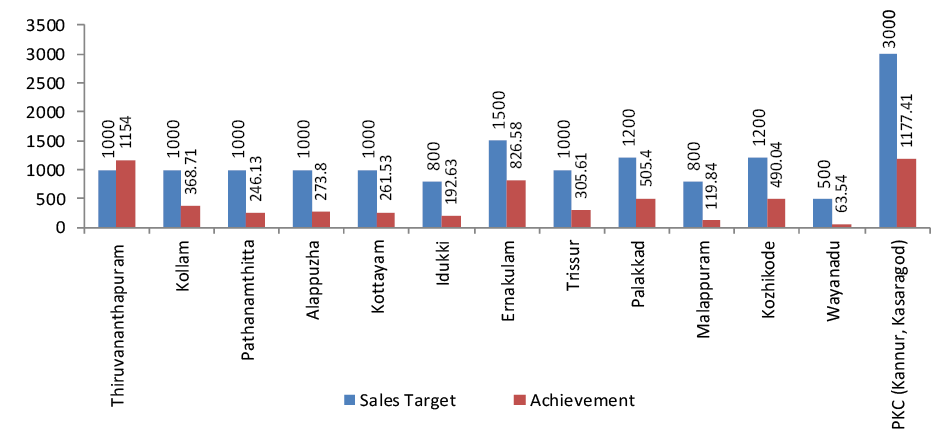
The KKVIB had 187 departmental sales outlets for Khadi and village goods in 2024-25. They generated a sales revenue of Rs 59.85 crore. District-wise details of departmental sales outlets and sales under KKVI Board for 2023-24 and 2024-25 are given in Appendix 4.6.18. Figure 4.6.1 portrays District-wise sales targets and achievement in 2024-25.
Figure 4.6.1
District-wise sales target and actual sale 2024-25, Rs in lakh
Source:Khadi and Village Industries Board, Government of Kerala.
Other Activities of KKVIB
- An amount of Rs 15 crore was provided to departmental institutions of Khadi Board and Khadi institutions as rebate to promote sales.
- An amount of RS 35 crore was disbursed to 12,500 spinners and weavers in Khadi sector under the income support scheme.
- An amount of Rs 5.60 crore was disbursed to Khadi workers as festival allowance.
Issues and Challenges of Khadi and Village Industries in Kerala
Poor marketing and branding are making it difficult for Khadi products in attracting customers, leading to low sales both online and offline. To receive Khadi certification and rebate on sale of product from KVIC, producers have to fulfill certain criterion. This limits their ability to access wider markets. Lack of innovation is another challenge, as Khadi Institutions (KIs) are not equipped to keep up with changing consumer preferences and adjust to shifts in market trends. Khadi products experience significant seasonal demand fluctuations, with certain products being more popular during specific times of the year due to various factors such as weather, cultural events, and fashion trends. Low wages for artisans are a major issue. Reluctance of young generation to enter the Khadi Sector is also problematic.
Way forward
Greater autonomy to Khadi institutions and support to increase competitiveness can address some of the challenges faced by the sector. Furthermore, empowering artisans through cooperatives or producer companies can guarantee fair wages and enhance their bargaining power. Innovation in product development and better marketing of products is essential in any industry. The khadi sector, being a traditional industry, is largely dependent on Government assistance. However, it is necessary to make the sector self-sufficient and adaptable to the changing economic environment. By promoting and ensuring the sustainability of businesses in this sector, the State can become a global leader in the sphere of sustainable traditional industries. Kerala's youth have a great potential to contribute to the growth of khadi with their innovative solutions and ventures. With substantial support from the Government and national institutes, the opportunities for entrepreneurship in this sector are at a high. The Khadi sector in Kerala requires greater momentum in its multi-faceted approach to address the challenges and ensure sustainability of this traditional industry. To meet the present-day challenges, Khadi institutions must enhance their professional management and capability. The sector can start of by changing their marketing strategies including the use of social media platform to create publicity among the masses.
COIR INDUSTRY
Coir Industry in India
Coir industry is important in terms of its contribution to Gross Value Added, employment generation and foreign exchange earnings. It provides direct and indirect employment to about 7.4 lakh persons, of which, about 80 per cent are women (Source: MSME-Annual Report-2024-25). Coir industry is predominantly concentrated in States like Kerala, Tamil Nadu, Andhra Pradesh, Karnataka, Maharashtra, Goa, Odisha, Assam, Andaman and Nicobar, Lakshadweep and Puducherry. Production of coir fibre increased from 7,96,300 MT in 2023-24 to 8,01,300 MT in 2024-25. India exported coir and coir products worth 4343.45 crore in 2024-25 (Up to March, 2025). India exports coir to more than hundred countries. India exports 14 coir products, including coir pith, coir fibre, tufted mats, handloom mats, geo textiles, coir yarn, curled coir, handloom matting and rubberised coir. (Source: Coir Board)
Coir Industry in Kerala
Kerala is the home of the Indian coir industry, particularly white fibre, accounting for 61 per cent of coconut production and over 85 per cent of coir products. Coir sector is the foremost traditional industry in Kerala in which nearly 1 lakh coir workers are directly and indirectly finding their livelihood. About 88,000 are enrolled as members in the Kerala Coir Workers Welfare Fund Board (KCWWF) of which around 80 per cent are women. The entire processes in coir industry can be divided into three major segments, namely fibre extraction, spinning and products sectors. The fibre extraction and spinning segments are mostly concentrated in the co-operative sector while the manufacturing segment is mostly running in factory mode with large presence of exporters.
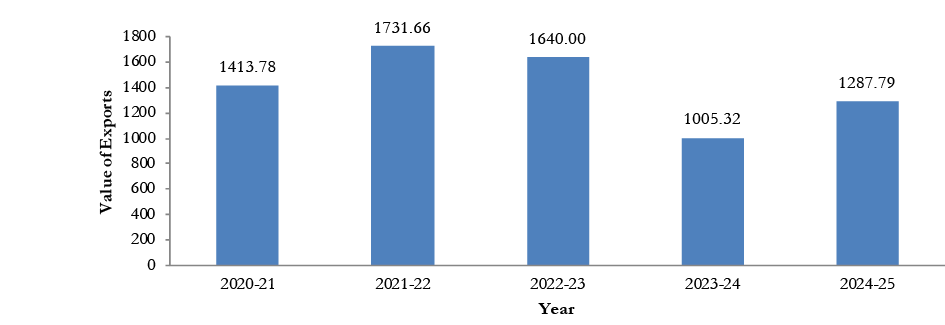
Coir industry is also significant to Kerala for its role in generating export earnings. State Public Sector Undertakings and private entrepreneurs are engaged in export of coir and coir products in Kerala. In Kerala, the Coir PSUs namely Kerala State Coir Corporation and Foam Mattings (India) Limited along with Coirfed are engaged in export of coir products. From Rs 1731.66 lakh in 2021-22, exports had decreased to Rs 1640.00 lakh in 2022-23 and Rs 1005.32 Lakh in 2023-24. However, exports increased to Rs 1,287.79 lakh in 2024-25. Recovery in global economy and Government efforts to promote the sector has led to subsequent increase in exports in 2024-25. Details are provided in Figure 4.6.2 and Appendix 4.6.19.
Figure 4.6.2
Export of Coir and Coir products by Kerala State PSUs and Coirfed, in Rs lakh
Source:Directorate of Coir Development, Government of Kerala
Performance under schemes and programmes in coir sector
In Kerala, Directorate of Coir Development (DCD) is the nodal agency to implement the schemes of coir industry. In the Thirteenth Five Year Plan, State Government allocated an outlay of Rs 636.19 crore for the sector through Annual Plans. The expenditure reported is Rs 628.19 crore (98.7 per cent). In addition, coir PSUs were also provided funds for organisational management and modernisation for continuous operations. Outlay for the sector in 2024-25 was Rs 107.64 crore as against the expenditure of Rs 71.55 crore (66.5 per cent). Details are provided in Table 4.6.6.
Table 4.6.6
State Plan Outlay and Expenditure for Coir sector, in Rs lakh
Year |
Outlay |
Expenditure |
Percentage of expenditure |
2017-18 |
12,812 |
9,872.89 |
77.06 |
2018-19 |
14,108 |
12,766.13 |
90.49 |
2019-20 |
14,151 |
8,247.06 |
58.28 |
2020-21 |
11,274 |
21,913.40 |
194.37 |
2021-22 |
11,274 |
10019.50 |
88.87 |
13th Five-Year Plan |
63,619 |
62818.98 |
98.74 |
2022-23 |
11,700 |
8,581.91 |
73.35 |
2023-24 |
11,700 |
6,857.93 |
58.61 |
2024-25 |
10,764 |
7,154.86 |
66.47 |
2025-26* |
10,764 |
3639.51 |
33.81 |
Source:Budget Programme Book, various years and Plan Space Kerala.
*Expenditure as on 31.11.2024
One of the most significant achievements in the coir sector in recent years has been the implementation of a comprehensive revival and transformational package called '2nd Reorganisation of Coir Industry'. Through the programme, effort is on to mechanise the coir sector and protect the wages of labourers, at the same time. The package includes State and National Cooperative Development Corporation (NCDC) fund. The package involves activities in 5 thrust areas namely i) Technology enabled procurement and decentralised fibre extraction, ii) Distinct strategy for traditional spinning and weaving sector, iii) Modernisation of industrial spinning and weaving sector (focussing on geotextiles), iv) Product diversification of industrial coir - focus on non-woven and v) Institutional support for the coir sector and dynamic markets. Modernisation and Mechanisation undertaken under the reorganisation package also benefit the sector.
Directorate of Coir Development and Agencies in Kerala Coir Sector
The Directorate of Coir Development acts as a facilitator for the promotion and sustainability of the coir industry in Kerala. Kerala State Coir Corporation (KSCC), Foam Mattings (India) Ltd (FOMIL), Kerala State Co-operative Coir Marketing Federation Ltd (Coirfed), National Coir Research and Management Institute (NCRMI), Kerala State Coir Machinery Manufacturing Company (KSCMMC), Kerala State Coir Workers Welfare Fund Board are the important agencies functioning for the promotion of coir industry. The co-operative sector plays a substantial role in activities like collecting husk, defibring, and production of yarn and other products in the coir sector.
Significant achievement of the sector in terms of schemes are highlighted below
- It has been possible to produce 11,900 tonnes of coir and 6,041.08 tonnes of fibre in the financial year 2024-25.
- Price of the coir produced by workers in the fibre societies have increased from Rs.3.50 to Rs.6.50 per Kilogram. The daily wages of the traditional workers have also increased from Rs. 350 to Rs.400.
- An amount of 12.48 crore rupees have been disbursed to 14,061 traditional coir workers under Income Security Scheme and thereby created 11,34,656 working days.
- Through the operation of new defibering units, the husk utilisation in the State has risen. New applications for pith and short fibre are discovered. As a result, the value of raw coir pith has risen.
- Over 26,000 good quality electronic ratts, and 1,493 Automated Spinning Mills (ASMs) in over 511 societies. Have been introduced. Mechanisation has resulted in yarn production has increased from 7,880 tonne in 2016 to 26976.25 tonne in 2024-25.
- In 2024-25, under the Coir Geo Textiles Development Programme, about 51 lakh square meters of coir geo textiles have been produced and supplied within the State.
- Coirfed and Coir Corporation participated in the 43nd India International Trade Fair -2024 (IITF-2024) held at Pragati Maidan, New Delhi from 14th to 27th November 2024 and won the best exhibitor award.
- In the financial year 2024-25, the National Coir Research and Management Institute (NCRMI) undertook research projects on enhancing the durability of coir textiles, developing coir-based biochar and activated carbon from coconut palm biomass residue for use as sustainable controlled-release fertilizers, and conducted field efficacy studies of the use of coir for roads works.
- Under the scheme, 'Regulated Mechanisation of Coir Industry', benefits to the tune of Rs 7.66 crore was disbursed to NCRMI, FOMIL, KSCC, Coirfed, KSCMMC, 313 Coir Vyavasaya Cooperative Societies (CVCS's) (infra),
5 defibering units (DF) for renovation. - The scheme 'Market Development Assistance' seeks to promote the sale of coir and coir products of co-operatives and PSUs thereby encouraging sustained production and better employment to workers. An amount of Rs 10.00 crore was distributed to 21 Mats and Mattings societies, Coirfed, FOMIL, and KSCC in 2024-25.
- The scheme 'Price Fluctuation Fund' intends to stabilize the price of coir fibre, yarn and coir products and an amount of Rs 42.06 crore was spent through KSCC, and Coirfed under the Scheme.
- To strengthen the share capital base of the co-operatives in the coir sector through the scheme 'Government Share Participation in coir co-operatives' support was provided to 3 co-operatives.
- The scheme 'Restructuring of Coir Production Societies and Managerial Subsidies' is for revival and rejuvenation of coir co-operative societies with working capital and managerial support. There were 267 societies that benefited from an amount of Rs 1.44 crore provided as managerial subsidy. About 109 societies benefited from an amount of Rs 52.5 crore provided as working capital.
- 'Production and Marketing Incentive' (PMI) scheme is for providing assistance to promote production, marketing and export of coir and coir products. In 2024-25, Rs 6.40 crore was provided to 391 CVCS's.
- Coir Corporation undertook the training of 350 traditional workers.
- KSCMMC made a remarkable entry into the international market and exported Rs. 23 lakh worth defibering units to Venezuela.
Coir Co-operative societies
The total number of coir co-operative societies in Kerala has decreased marginally from 1,099 in 2023-24 to 1055 in 2024-25. The number of working societies has reduced from 511 in 2023-24 to 492 in 2024-25. While the number of profitable societies decreased from 290 in 2021-22 to 209 in 2024-25, the number of loss-making societies has also decreased. Similarly, the number of dormant societies and those under liquidation have decreased. Almost 47 per cent of the total number of working societies is primary co-operative societies engaged in the yarn sector. The non-yarn sector includes manufacturing societies (mats and mattings) and small-scale producers' co-operative societies. The total number of manufacturing societies (mats and mattings) and the number of small-scale producer's co-operative societies has remained more or less stagnant. Details are provided in Appendix 4.6.20.
The two important sub sectors within the coir industry are yarn sector and product sector. The number of workers engaged in the coir co-operative societies in the yarn sector has increased from 17,257 in 2023-24 to 17,731 in 2024-25. The amount of wages paid in the sector increased from Rs 28.22 crore in 2023-24 to Rs 38.76 crore in 2024-25. Compared to 2023-24, the value of husk procured, the value of fibre purchased and the value of yarn produced have increased in 2024-25. The number of workers in the product sector in the co-operative societies has also increased significantly in 2024-25 compared to the previous year. Details are provided in Appendix 4.6.21.
Coirfed
The Kerala State Co-operative Coir Marketing Federation Ltd (Coirfed) is the apex federation of primary coir co-operative societies spread all over Kerala. Coirfed has 11 factories for producing various coir related products and runs around 50 signature shops throughout the country. The main objective of the federation is procurement of the products of the member societies and marketing of these goods through its sales outlet. The process helps in providing fair wages and subsistence to the coir workers of Kerala. Coirfed has two facilities for the manufacturing of value-added products. One factory produces rubberised coir products and the other produces rubber backed coir mats. Coirfed has 4 defibering units. Income from sales has decreased from 2020-21 to 2022-23. However subsequently, income from sales has increased from Rs 87.99 crore in 2023-24 to Rs 88.94 crore in 2024-25. As a whole, the annual net loss of the agency has been decreasing since 2020-21. Details are provided in Appendix 4.6.22.
Kerala State Coir Corporation
The Kerala State Coir Corporation Ltd was established in 1969 to help the small-scale coir manufacturers by providing them assistance in manufacturing and marketing. Over the years, the Corporation has been procuring the produce of small-scale manufacturers, thereby reducing their dependence on the intermediaries. They provide the procured products to exporters and other sellers. KSCC also runs 11 showrooms (8 in Kerala and 3 outside Kerala). The Kerala State Coir Corporation has 3 production centres in Kerala. One more unit is being established in Adoor. The products produced/traded by the corporation include PVC tufted Coir mats/mattings, Coir pith, Coir yarn, Coir fibre and curled rope. KSCC exports their products to various countries including Australia, Brazil, USA, Poland, France, Kuwait, Kazakhstan and Guatemala.
The corporation implements the Purchase Price Stabilisation Scheme (PPSS) in coir sector. Value of procurement under the PPSS has decreased from 2020-21 to 2022-23. However, it has increased from 108.14 crore in 2023-24 to Rs 125.19 crore in 2024-25. The income from sales of products increased from Rs 147.50 crore in 2023-24 to Rs. 165.33 crore in 2024-25. The PSU has continuously reported net profit in recent years. Its net profit has increased from Rs 32.16 lakh in 2020-21 to Rs 105.02 lakh (Provisional) in 2024-25. The PSU has successfully reduced its accumulated losses in recent years and has recorded an accumulated profit in 2024-25. Details are provided in Appendix 4.6.23..
Major achievements of the KSCC
- Company opened a new showroom at Lulu Mall Trivandrum. This is the first ever PSU showroom in the Lulu Mall.
- Started exporting to UK and Dubai.
- Opened a new showroom at Military Canteen Pangode, Trivandrum.
- A new premium coir craft outlet was inaugurated in Alappuzha office.
- Managing Director of the company was awarded as the best Managing Director in PSU for 2024-25 by the State Government.
- KSCC won the 'MKK Nayar Productivity Award 2024' from Kerala State Productivity Council for 2nd Best Performer among Medium Industries.
- KSCC won the 'Dalam 2025' award for Best Performer in PSU,s from Asianet Satellite Communication Limited.
- Company has executed an agreement with Walmart for selling of coir products in their US platform and first container carry coir products shipped to USA.
- Company got an order from Odisha Mining Corporation for the supplying and laying of coir Geotextiles in Iron ore mines.
National Coir Research and Management Institute (NCRMI)
The NCRMI is setup to strengthen the research and development activities of coir sector with a view to enabling the industry to produce more value-added products and new design products at competitive price.
The activities of the research institute in 2024-25 can be classified under the following heads -
- Demonstration projects including application of coir geotextile as mulch, coir geocell and its application in different parts of Kerala, field efficacy studies on coir road divider, durability enhancement of coir geotextiles, training programme on production and demonstration of coir textiles for SC women aspirants and coir pith compositing, training initiative for SC community empowerment in Kerala.
- Technology development includes utilization of coir pith for the production of bio plastic using significant microbial strains, optimization of pith activator for the composting of household organic waste using passive aeration bin, technology dissemination & training of coir pith composting to the workers of defibering units, collaborative project for the fortification and enrichment of coir pith compost and its evaluation, development of biofilm on coir based biomass carriers for treating effluent water, development of bacterial consortia to treat ret liquor, treatment of coir fibre with various biological and chemical agents to improve the texture and colour, technology transfer Patent achievement of COCOAURA
- Commercial activities including PEATKOL Dots, Ecoir bag, trichopith spawn production, pith activator, new Trichoderma strain for coir pith composting, coconuture - (A new potting filler), identification and characterisation of microorganisms including bacteria and fungi in automated systems and supply of mother culture on behalf of Department of Agriculture, Kerala.
- Machine activities includes design and fabrication of pyrolysis unit for the conversion of coconut palm biomass residues to biochar for soil, development of fully automatic creel mat loom, technology for blended yarn making
- Conduct of skill development training programs
- Participation in exhibitions and workshops
- Sponsored live workshop in association with Ernst & Young and Viswa Santhi Development Foundation
- Testing facility and extension activities
Foam Mattings (India) Limited (FOMIL)
Foam Mattings (India) Limited (FOMIL) is a Government of Kerala undertaking founded in 1979. The company is engaged in the production, manufacturing and marketing of coir, jute and sisal products under the brand name FOMIL. It was established with an authorised capital of Rs 800 lakh and paid-up capital of Rs 666.73 lakhs. FOMIL caters to the needs of domestic and international markets with a wide range of products - mattings, door mats, rugs, carpets, coir tiles, car mats, coir geotextiles and a host of other environment friendly products. Company has released novel gift packs of foot mats, carpets and floor decors made from coir and jute fibre. The company has state of the art facilities like Latex Backing Plant, Modern Dye House, and Fully Automatic Power loom where spare capacity is used for undertaking works of other exporters. New products from the company like coir pith manure and coir tiles are having good demand in the market. FOMIL have introduced a new product called digital printed jute mattings. FOMIL has established a brand name of FOMIL in the mattress market with a definite sales volume.
The State PSU has reported loss in the last 5 years and the accumulated loss of the PSU was estimated to be about Rs 17.35 crore at the end of 2024-25. Income from the sale of products has increased from Rs 13.01 crore in 2023-24 to Rs. 16.51 crore in 2024-25. Details are provided in Appendix 4.6.24.
Kerala State Coir Machinery Manufacturing Company Ltd (KSCMMC)
Kerala State Coir Machinery Manufacturing Company Ltd (KSCMMC) was established in 2014, in Alappuzha by the Government of Kerala for the organisation of Coir Industry, to provide the machinery needed for the coir sector in Kerala. Company has a well-established machine shop, Quality Assurance Department, Research and Development Department, Marketing and after Sales Service Department. Since its inceptions KSCMMC has manufactured and installed 174 defibering mills so far and an increase in coir fibre production was registered from 7,000 tonnes to 30,000 tonnes. It has manufactured and supplied 29,832 electronic ratts having production capacity of 15 to 18 kg yarn in a single shift. Around 1,500 Automatic Spinning Machines having production capacity of 50-80 kg per shift were also manufactured and installed in coir co-operative societies in Kerala. The increased production of coir yarn through automatic spinning machines by KSCMMC has played a key role in the increase of wages of coir workers in the State. In addition to coir machines KSCMMC is manufacturing waste management machineries like bottle booth, mini MCF, metal trolley, sorting conveyors/sorting tables, deduster, shredder, glass bottle crusher and bailing machines. KSCMMC developed a Magnetic Loom (Magloom) that works with PLC control and VFD motors. Company manufactured and delivered a wide range of waste management machineries to different LSGD across Kerala. The company also carried out fabrication and machining works for various reputed PSUs like BATL, KAMCO and HLL.
The sales revenue of KSCMMC has fluctuated between Rs 32.88 crore in 2020-21 to 3.70 crore in 2024-25. The company reported a net profit of Rs 81.49 lakh in 2022-23, but in 2024-25 the company reported a net loss of Rs.71.43 lakh. In recent years, the demand for coir machinery seems to have reached a saturation point, resulting in a significant slowdown in new orders. Consequently, the company has initiated steps to diversify their business verticals, though these efforts are still in the preliminary stage. As a result, turnover has been steadily declining the past few years. Details are provided in Appendix 4.6.25.
Central Government Schemes
The Central Government has implemented various schemes for the Coir sector. The Coir Board a promotional body functioning under the Government of India is implementing various schemes for the promotion of the coir industry across the country. It is the implementing agency for Coir Vikas Yojana, and other central sector schemes like Scheme of Fund for Regeneration of Traditional Industries (SFURTI), Prime Minister's Employment Generation Programme (PMEGP), and Scheme for Promotion of Innovation, Rural Industries and Entrepreneurship (ASPIRE). For the country as a whole, there are 17,332 coir units and 2179 coir exporters registered with the Coir Board. Under the Umbrella scheme Coir Vikas Yojana (CVY), the Coir Board has been implementing various sub-components for Science and Technology, Skill upgradation and Mahila Coir Yojana, Domestic and Export market promotion and Trade and Industry related functional support services in coir sector. In 2024-25, a total of 2,121 people were trained under various training programmes of the Board. In addition, 22 Entrepreneurship Development Programmes (EDPs), 25 awareness programmes, 7 national seminars, 10 workshops and 5 exposure tours were organised. A total of 122 entrepreneurs were supported to attend 5 international exhibitions abroad. Out of them, 59 entrepreneurs were from Kerala. Under domestic market promotion Coir Board has participated in 30 exhibitions. Market Development Assistance worth Rs 36.97 lakhs was disbursed to different State governments.
Under the scheme of Fund for Regeneration of Traditional Industries (SFURTI) of the Government of India, Coir Clusters are being established in different coconut producing States/UTs. This is to pave the way for a faster growth of the coir industry in the country. Out of the 40 clusters approved, 4 are in Kerala. The coir industry under the purview of Prime Minister's Employment Generation Programme (PMEGP) is expected to contribute to employment generation in the sector especially for the youth. Under the scheme PMEGP, 29 units were provided assistance in the year 2024-25.
Expert committee on coir and recommendations
An expert committee was constituted by the Government in August 2022 for suggesting measures to revive the sector. It submitted its report on 01.01.2025. The following are some of the recommendations of the committee.
- Kerala should find ways to ensure better availability of raw material for the coir industry in the State.
- Enhance the role of KSCMMC and NCRMI for modernizing coir producing machines and ensure the utilisation of these machines at full capacity. This will help to produce quality products with low production cost and thereby compete in the market.
- Change the market strategy to focus on products that are in demand in the market.
- Strengthen the R&D activities of NCRMI to develop a system for collecting coir of different runnage in ASM machines. A design department under NCRMI is to be developed for innovation in products and designs and for diversifying small producers and coir groups.
- The quality of the product needs to be ensured in the coir production and coir spinning sectors.
- Adopt a PPP model for utilising the land and infrastructure of dormant societies. The land could be given on contract/lease basis to small scale producers/ exporters. Employees who were working earlier in these societies could be retained.
Challenges and the way forward
The coir industry has been facing challenges including relatively low wages, shortage of raw materials, lack of advanced models for procurement of raw material, modern techniques of production and organisation. Government has taken comprehensive measures for the upgradation and devolvement of coir sector. This includes, technological upgradation, regulation of market-driven price fluctuations, developing self-sustaining units, innovations, competitiveness, diversification and tapping of new markets. The emphasis has also been given to develop an eco-friendly coir sector in the context of climate change.
CASHEW INDUSTRY
As per 2024-25 Globel Tree Nut Production, almond leads (27 percent) fallowed by pistachios (20 per cent) and cashew (19 per cent). Pistachios and cashews fallow with similar shares, contributing 20% and 19% respectively. As per the Nuts and Dried Fruits Statistical Yearbook 2025 of the International Nut and Dried Fruit Council (INC), global cashew production has been increasing over decade. In 2024-25, global production of cashew was 11.66 lakh metric tons (kernel basis) or 53.66 lakh metric tons of raw cashew nuts. India is a major producer (of raw cashew nut and kernels), consumer and exporter of (shelled) cashew nut. Details of production of cashew by leading producers are given in Table 4.6.7.
Table 4.6.7
Top producers of cashew nut-in 2024-25, in MT
Rank no |
Region/Country |
Production |
Per cent share |
1 |
Western Africa |
5,43,814 |
51 |
2 |
India |
1,63,152 |
15 |
3 |
Cambodia |
1,32,940 |
12 |
4 |
Vietnam |
89,240 |
8 |
5 |
Eastern Africa |
80,388 |
8 |
6 |
Brazil |
26,932 |
3 |
7 |
Others |
33,960 |
3 |
Source:Nuts and Dried Fruits Statistical Yearbook 2025, INC-International Nuts and Dried Fruit Council
Vietnam was the leading exporter of cashew (kernel equivalent) in 2024 (January-December), accounting for 33 per cent (4.67 lakh metric ton) of global exports. Cote d' Ivore was the second leading exporter of 14 per cent (1.96 lakh metric ton). In the calendar year 2024 (January to December), India was the seventh largest exporter of cashew kernels, with an export of 51,100 metric tons and a share of 4 per cent in global exports. Sharing the same 4 per cent, the Netherlands, as a transit country, got the sixth position (which exports 51,777 metric tons).
India ranks second in the import of Cashew as a transit and processing country (kernel equivalent) and imported 2.99 lakh metric ton of Cashew (kernel equivalent) in the calendar year 2024. Viet Nam as a transit and processing country occupied the top position with an import of 3.98 lakh metric ton.
India is the top consumer of Cashew among the world countries, consuming about 3.95 lakh metric ton of Cashew (kernel equivalent) in the calendar year 2024. In consumption, second position went to USA, with consumption of 1.74 lakh metric tons in the calendar year 2024. Source: Nuts and Dried Fruits Statistical Yearbook 2025, (INC-International Nuts and Dried Fruit Council).
Researchers at various parts of the globe note an evolving interest in plant-based and vegan diets, and increased consumer interest in healthier snack options fostering an upsurge in the demand for cashew based products. This signifies better prospects for growth in the cashew market.
Cashew Sector in India
India is among the major cashew producing countries globally. India remains the world's largest consumer of cashews, processing almost half of global cashew kernels and consuming 40 per cent of the global output. The United States is a distant second, accounting for 10-15 per cent of global consumption. India exports only 10 per cent of its output, down from 35 per cent in pre-pandemic times. This is because of an overwhelming rise in domestic demand, replacing the exports.
In India, cashew cultivation prevalent in Kerala, Karnataka, Goa, west cost of Maharashtra, Tamil Nadu, Andhra Pradesh, East cost of Odisha and in some areas of West Bengal, Chhattisgarh, Gujarat, Jharkhand and the North-eastern States. According to the Directorate of Cashew and Cocoa Development (DCCD), in India, cashew was grown in 12.04 lakh hectares with a total production of 7.03 lakh MT of RCN in 2024-25. Compared to 2023-24, the total area under cultivation has increased marginally but the total production has witnessed a decline of more than 11 per cent. Maharashtra is the largest producer followed by Andhra Pradesh and Odisha. In terms of total production of raw cashew, Kerala ranks 6th (0.65 lakh MT) among the producing states. Odisha has the largest area under cashew nut (2.23 lakh hectres) followed by Andhra Pradesh (2.01 lakh hectres) and Maharashtra (1.95 lakh hectres). Kerala has an area of 1.10 lakh hectres under cashew production and is sixth in terms of area under cashew production. State wise details of cashew nut production and area are provided in Appendix 4.6.26. A brief picture is provided in Figure 4.6.3.
Figure 4.6.3
Area and production of Raw Cashew Nuts in major producing states in India (2024-25)
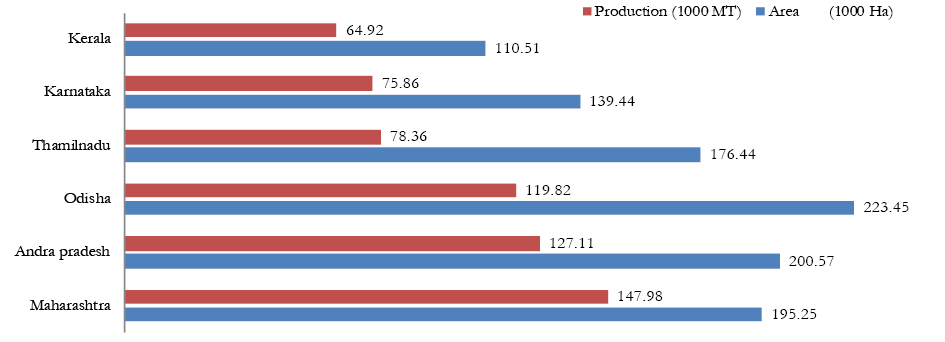
Source:Directorate of Cashew and Cocoa Development (DCCD), Government of India
Productivity in the cultivation of cashew across major producing states is provided in Fig 4.6.4. Productivity has fallen considerably in 2024-25. Among the states compared, productivity is highest in Maharashtra and lowest in Tamil Nadu. As a whole, productivity in cashew cultivation in Kerala has fallen in the reference period.
Figure 4.6.4
Productivity in major cashew producing states of India
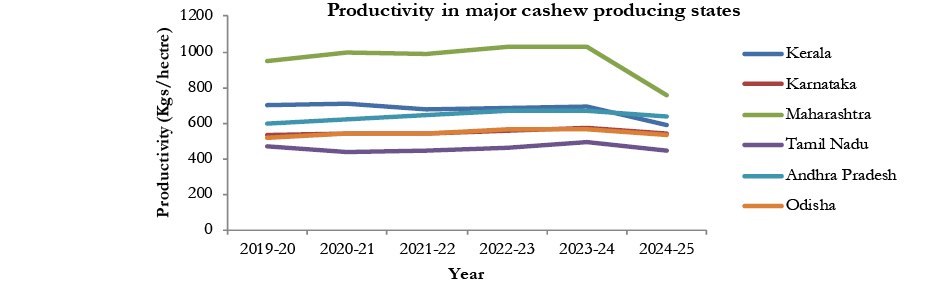
Source: Directorate of Cashew and Cocoa Development (DCCD), Government of India
Cashew Kernels are graded into white or scorched wholes, pieces, splits, butts, depending on the shape, size and colour of the kernel. The Export (Quality Control and Inspection) Act 1963 prescribes 33 different grades of cashew kernels. W-180, W-210, W-240, W-320 and W-450 are some of the popular grades of cashew produced in India.
According to the Cashew Export Promotion Council of India (CEPCI), the export of cashew kernels from India, in terms of quantity, has been decreasing since 2019-20. In 2024-25, the total quantity of export of cashew kernels from India was 37,084 MT, registering a decrease of 19.79 per cent compared to cashew kernel export of 46,235 MT in 2023-24. The export of cashew kernels from India, in terms of value has been on decrease since 2021-22. In 2024-25, the total value of export of cashew kernels from India was Rs.2473.11 crore, indicating a decline of 5.6 per cent compared to 2023-24. Details are provided in Figure 4.6.5.
Figure 4.6.5
Export of Cashew Kernels from India (since 2019-20)
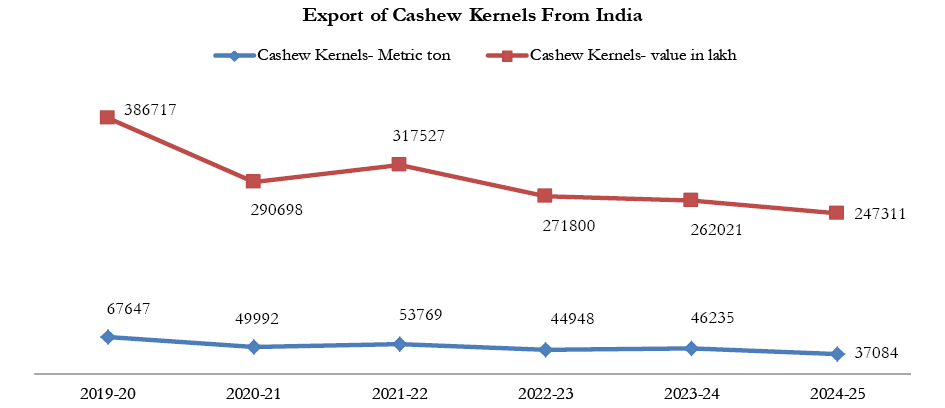
Source:Cashew Export Promotion Council of India (CEPCI)
During 2024-25 a major portion of cashew kernels are exported to the UAE, i.e., 10034.38 MT; subsequently, the main exports are to the Netherlands, Japan, Saudi Arabia, and Spain. Kuwait, Qatar, and the USA are also the major markets of Indian cashew kernels.
Export of roasted & salted cashew kernels from India has been fluctuating since 2019-20. Compared to 2023-24, Export of roasted & salted cashew kernels from India in 2024-25, increased 18.5 per cent in terms of quantity and 6.4 per cent in terms of value. In 2024-25, a total of 3,020 metric ton of roasted & salted cashew kernels had been exported from India, worth Rs.201.02 crore. A quick look is provided in Figure 4.6.6.
Figure 4.6.6
Export of Roasted & Salted cashew kernels from India (since 2019-20)
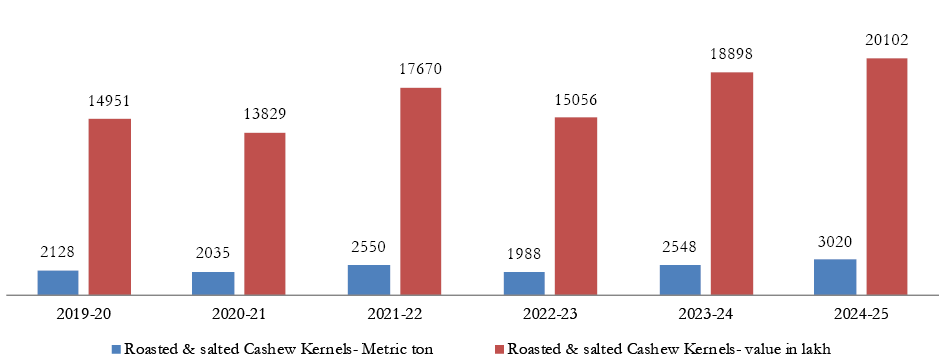
Source: Cashew Export Promotion Council of India (CEPCI)
The domestic production of cashew nut in India is not sufficient to cater to the cashew processing industry's current requirement or installed processing capacity of about 20 lakh MT. Hence, India imports raw cashew nut from other countries. India had imported a total of 11.41 lakh MT of Raw Cashew Nut (RCN) in 2024-25 valued at Rs 13,742 crore. In 2023-24, it was 12.51 lakh MT valued at Rs. 11,633 crore. Compared to 2023-24 import of RCN by India has declined in terms of quantity (8.77 per cent). The average import price of raw cashew nuts in FY 2024-25 was Rs. 120.38 per kg; compared to the previous year's price of Rs. 92.96 per kg, it shows an increase of 29.49 per cent. Ivory coast, Tanzania, Guinea Bissau, Benin, Ghana, Mozambique, Nigeria, Senegal are the major sources of RCN import. (Cashew Export Promotion Council of India- CEPCI). Large variations over the years in the export and import of raw cashew nut are primarily due to the activities of traders in the processing industry. There are large fluctuations in the international prices of raw cashew nut and cashew kernel. Moreover, market conditions in other processing countries affect international trade.
India is also importing cashew kernels. The quantity of cashew kernel import was 6210 MT valued at Rs 340.79 crore in 2024-25, it includes wholes, broken and others (Cashew Export Promotion Council of India - CEPCI). There's been a huge increase in terms of quantity and value compared to 2023-24. The import of low processed, low quality, finished/semi-finished kernels to India from competing countries by miss-declaration and misusing certain policy norms is a concern to the Indian cashew industry. Details are provided in Figure 4.6.7.
Figure 4.6.7
Import of Cashew Kernel into India (since 2019-20)
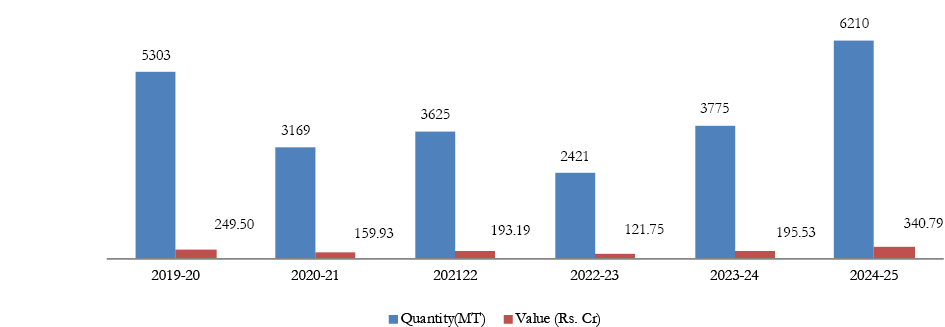
Source:Cashew Export Promotion Council of India (CEPCI)
Export of cashew nutshell-liquid from the country in 2024-25 was 8497.61 MT (valued at Rs.60.79 crore). In comparison to the export of 2023-24, there was a decrease in terms of quantity of 35.73 percent and value of 21.26 per cent, i.e., the export was 13222.27 MT and the value was Rs.77.21 crore (Cashew Export Promotion Council of India - CEPCI).
Cashew Sector in Kerala
The cashew industry is a major traditional agro-based industry in Kerala. Cashew kernels are obtained through processing (roasting or steaming, shelling and peeling) of raw cashew nuts. The cashew processing industry in Kerala is clustered in Kollam District in Kerala, which is traditionally known as the global cashew trading capital. Cashew processing in Kerala has been a labour-intensive industry and has a long history of employing a large number of women workers. It is estimated that the number of working cashew processing units is about 100 where approximately 1 lakh workers are employed. About 65 per cent of the cashew exporting and processing units officially registered with the Cashew Export Promotion Council of India (CEPCI). Cashew processing is concentrated mainly in the private sector. The co-operative sector has limited presence in cashew processing.
There are two public institutions engaged in the cashew processing industry in Kerala, namely Kerala State Cashew Workers Apex Industrial Co-operative Society Ltd (CAPEX) and Kerala State Cashew Development Corporation (KSCDC). The Kerala Cashew Board (KCB) is engaged in the import of raw cashew nut for these two public institutions. Kerala State Agency for the Expansion of Cashew Cultivation (KSACC) is engaged in promotion of cashew cultivation and adoption of innovative technologies to enhance area, production and productivity of cashew.
According to Cochin Port Trust, the quantity of cashew kernels exported from Cochin Port in 2023-24 was 22,753 MT, showing a growth of 4.09 per cent as compared to the export of 21,858 MT in 2022-23. In 2024-25 the export of cashew kernels was 15495 MT, showing a decline of 31.9 per cent as compared to 22753 MT in 2023-24. This is 41.8 per cent of the total cashew kernel export from India (37,084 MT).
In Kerala the production of raw cashew nut increased from 80,000 MT in 2014-15 to 88,180 MT in 2017-18. Subsequently production of raw cashew nuts has shown fluctuations annually. However, has declined as a whole in recent years to reach 64,920 MT in 2024-25. The area under cultivation of cashew has increased from 84,500 hectares in 2014-15 to 1,10,510 hectares in 2024-25. Mismatch between area and production is attributed to replantation and gestation period for production. Significant share of area under cashew cultivation have not been replanted. A major reason limiting improvement in production/productivity in cashew cultivation is the fact that nearly 70 per cent of the cashew trees in the State are aged, local varieties, which start yielding late in the season. Climate change effects such as the coincidence of excessive rainfall and high relative humidity have also adversely affected cashew cultivation. Details are provided in Table 4.6.8.
Table 4.6.8
Production of raw cashew nut in Kerala - 2014-15 to 2024-25, in hectares and MT
Year |
Area (in 1000 ha) |
Annual growth, in % |
Quantity (in MT) |
Annual growth, in % |
2014-15 |
84.50 |
-0.4 |
80,000 |
-0.2 |
2015-16 |
87.00 |
2.9 |
72,000 |
-10.0 |
2016-17 |
90.87 |
4.5 |
83,980 |
16.6 |
2017-18 |
92.81 |
2.1 |
88,180 |
5.0 |
2018-19 |
96.65 |
4.1 |
82,889 |
-6.0 |
2019-20 |
98.82 |
2.2 |
69,624 |
-16.0 |
2020-21 |
103.21 |
4.4 |
73,105 |
5.0 |
2021-22 |
106.52 |
3.2 |
71,760 |
-1.8 |
2022-23 |
108.59 |
1.9 |
74,630 |
4.0 |
2023-24 |
110.26 |
1.5 |
76,380 |
2.2 |
2024-25 |
110.51 |
0.23 |
64920 |
-15 |
Source:Directorate of Cashew and Cocoa Development (DCCD), Government of India
The challenges in the expansion of cashew cultivation in Kerala include the pressure on land, and the erstwhile shift to cash crops like rubber (particularly due to the absence of plantation status to cashew). Many of the cash crops have a long gestation period and to be economic, the activity has to be continued for a relatively longer period of time. Hence, an immediate large shift to cashew from other cash crops is not possible.
In the last decade, Kerala has initiated steps to expand the area under cultivation of cashew, cashew production, and productivity. Though positive changes are visible, there is further scope for improvement. A trend of more farmers accepting cashew as a remunerative crop is visible.
Agencies in Cashew Sector
Kerala State Cashew Development Corporation (KSCDC) and Kerala State Cashew Workers Apex Co-operative Society (CAPEX) are the two State Government agencies involved in the processing of cashew in the State. Kerala State Agency for the Expansion of Cashew Cultivation (KSACC) and Kerala Cashew Board (KCB) are the other two State Government agencies in the sector. Cashew Export Promotion Council of India (CEPCI) and the Directorate of Cashew and Cocoa Development (DCCD) are the other agencies involved in cashew promotion. The details regarding the outlay from State Annual Plan and expenditure incurred in 13th five-year plan and financial year 2024-25 and 2025-26 are provided in Table 4.6.9.
Table 4.6.9
Plan outlay and expenditure of State Government agencies in cashew sector, 13th Five-Year Plan, 2024-25 and 2025-26(in Rs crore)
Sl no |
Agency |
13th Five Year Plan |
2024-25 |
2025-26 (as on 31-10-2025) |
||||||
Outlay |
Exp |
% |
Outlay |
Exp |
% |
Outlay |
Exp |
% |
||
1 |
Kerala Cashew Board Ltd |
115.20 |
100.10 |
86.89 |
40.81 |
40.81 |
100.00 |
41.00 |
41.00 |
100.00 |
2 |
Kerala State Cashew Development Corporation |
98.00 |
239.55 |
244.4 |
3.05 |
1.47 |
48.20 |
3.05 |
0.80 |
26.23 |
3 |
Kerala State Agency for the expansion of Cashew Cultivation |
30.80 |
13.39 |
43.47 |
6.50 |
3.25 |
50.00 |
6.31 |
2.20 |
34.87 |
4 |
CAPEX |
25.00 |
61.02 |
244.1 |
3.00 |
0.93 |
31.00 |
3.00 |
1.05 |
35.00 |
Total |
269.00 |
414.06 |
153.93 |
53.36 |
46.46 |
87.06 |
53.36 |
45.05 |
84.43 |
|
Source:Plan Space, State Planning Board
Kerala State Cashew Development Corporation (KSCDC)
Kerala State Cashew Development Corporation Ltd. (KSCDC) was formed in 1969 as a company fully owned by the Government of Kerala. KSCDC currently operates 30 factories, of which 20 are private factories run by KSCDC based on agreement. Modernisation of facilities and purchase of cutting machines have increased the productivity from 85 MT per day to 115 MT per day. KSCDC has achieved this productivity without any labour reduction.
The number of working days and turnover has fallen since 2019-20. The first and second waves of the covid-19 pandemic have adversely affected the operations of KSCDC during the financial years of 2021-22 and 2022-23. But from 2023-24 onwards, the working days and turnover are increasing gradually. The turnover for 2022-23 was 93.49 crores, but coming to 2023-24 and 2024-25, the turnover is showing an increasing trend, i.e., 134.31 crores and 166.62 crores, respectively, and with the increasing trend of turnover, the loss of the firm is also reducing. KSCDC currently provides employment to around 9000 workers; the majority of them are women who depend on this job as their sustenance. Details are given in Table 4.6.10 and Appendix 4.6.27..
Table 4.6.10
Sales turnover of KSCDC, in Rs crore
Period |
Turnover |
Cost of raw material |
Cost of human power |
Profit / Loss |
2019-20 |
173.13 |
120.13 |
75.38 |
-44.56 |
2020-21 |
88.31 |
80.88 |
62.12 |
-89.15 |
2021-22 |
112.24 |
76.39 |
61.64 |
-77.83 |
2022-23 |
93.49 |
83.61 |
52.54 |
-94.52 |
2023-24 |
134.31 |
103.16 |
57.79 |
-105.86 |
2024-25* |
166.62 |
112.17 |
79.30 |
-81.15 |
Source:KSCDC, Kollam
Note: * Provisional
KSCDC is marketing its value-added products and trying to sell more products directly to the end customers which are giving it better margins. The agency has launched new products such as gift hampers (250-gram tins, platinum and premium boxes), assorted premium cashews and jumbo cashews. These products have received good response from customers. KSCDC has also started outlets to increase the sales. It supplies grafted saplings in grow bags, at a discounted price. Details regarding performance of KSCDC can be found in Appendix 4.6.28.
Due to the presence of the covid-19 pandemic, the working days provided to workers during 2020-21 and 2021-22 were 89 and 96, respectively. Even though there was an acute shortage of raw cashew nuts across the globe in 2022-23, KSCDC provided 71 working days to the workers. In 2023-24 & 2024-25, KSCDC provided 123 and 127 working days, respectively, to the workers. KSCDC has also developed new value added products like Cashew Vanilla Milk shake, Cashew vita cardamom/Choclate/Pizta/Vanila and flavoured cashew including chilly garlic/salt& pepper/Red chilly etc, which have good acceptance from customers. KSCDC is also trying to increase the sale of CDC-branded cashew packets named 'Kerala Cashew' and value-added products like cashew soup, cashew powder, cashew vita, and cashew apple soda. KSCDC has rebranded its retail products as 'Kerala Cashews' for better acceptance; the products with "brand value" command a premium price and also sell better.
Kerala State Cashew Workers Apex Industrial Co-operative Society Ltd. (CAPEX)
CAPEX was set up at Kollam in 1984 as an apex body to take care of the operations of factories of 10 primary co-operative societies under Government of Kerala. The State Government created the framework for CAPEX by purchasing the dormant cashew factories. Its major function includes procurement, management of processing through co-operative societies and marketing. It procures raw nuts, distributes the same to the primary societies and gets them processed, and markets the kernels. These are done with the aim of bringing down the processing costs and providing continuous employment and fair wages to the workers.
In 2024-25, CAPEX provided employment to 3592 workers. About 95 per cent of workers are women workers. CAPEX had provided 155 working days in the financial year 2023-24 and 165 working days in the financial year 2024-25. Various efforts had been taken by CAPEX to reduce the loss from Rs.16.41 crore in 2015-16 to Rs.7.58 crore in 2024-25. Turnover of the firm is also steadily increasing year by year, i.e., in 2022-23, Rs.53.87 crore; in 2023-24, Rs.54.37 crore; and in 2024-25, Rs.56.71 crore. Details regarding sales and turnover of CAPEX are given in Table 4.6.11.
Table 4.6.11
Sales turnover of CAPEX, in Rs crore
Year |
Working Days |
No. of Workers |
Total Sales Turnover |
Raw material cost |
Cost of human power |
Profit / Loss |
2019-20 |
206 |
4209 |
85.19 |
50.87 |
32.75 |
-16.95 |
2020-21 |
142 |
4130 |
46.89 |
44.74 |
24.44 |
-17.56 |
2021-22 |
179 |
4100 |
63.15 |
42.40 |
29.24 |
-22.24 |
2022-23 |
93 |
3970 |
53.87 |
43.65 |
20.34 |
-11.04 |
2023-24 |
155 |
3797 |
54.37 |
44.14 |
25.28 |
-18.87 |
2024-25 (Provisional) |
165 |
3592 |
56.71 |
36.24 |
26.95 |
-7.58 |
Source:CAPEX
Note: * Annual audit in progre
CAPEX acts as a model employer by providing employment opportunities to the closed private factories, thereby assuring wages and other benefits as per the existing law (ESI, PF, and bonus etc). CAPEX is making bulk/wholesale sales, which are done through e-tenders, and also expanded the retail sales of branded cashews named "Capex Cashew" through various government channels like Kerala Police Canteens, Consumerfed, Supplyco, Shipyard Canteen, PSU's, supermarkets, own outlets, etc. CAPEX launched value-added products like cashew butter, cashew powder, jam, pickles, and cashew apple syrup. Online sales are done through ONDC, the Kerala government platform 'Kshoppe,' and through the CAPEX website.
During the first four years of the 14th FYP, CAPEX provided more employment to workers, increased the number of working days per year, and reduced the loss as a result of partial mechanization and modernization. About, 90 per cent of the shelling and 30 per cent of the borma work are mechanized. The introduction of solar panels reduced the cost of electricity significantly, and the basic amenities of all the factories have been improved a lot. Computerization in the manufacturing unit and implementation of proper safety measures improved the working environment. The introduction of six more value-added products and the increasing sale of consumer products in the market are remarkable achievements of the firm. One of the significant achievements during the period is the appointment of 252 new workers in the factories of CAPEX. Details regarding the functioning of CAPEX are given in Appendices 4.6.29. and 4.6.30
Kerala State Agency for the Expansion of Cashew Cultivation (KSACC)
KSACC was constituted by the Government of Kerala in 2007 to promote cashew cultivation and to ensure adoption of innovative technologies to enhance area, production and productivity of cashew. KSACC started the project 'Cultivation of Organic Cashew and Establishment of Raw Nut Bank' from 2007-08.
In 2024-25, the agency distributed 5,09,995 grafts among farmers and institutions, which is estimated to cover around 2009.09 hector. In 2025-26 (till Sept) a total of 3,15,000 grafts have been distributed and the production of grafts saplings by the Govt. nurseries is progressing. There are Two Model Cashew Gardens in Kerala, One is located in the premises of Kerala State Cashew Development Corporation and the other is at the Open Jail at Nettukaltheri in Thiruvananthapuram. Through its scheme KSACC supports farmers for undertaking normal density, high density and ultra-high density cashew farming. Support includes supply of grafts and assistance to ensure growth of saplings, and training among others. An area of 10 Hectare has been covered under the 'pollination support through bee keeping' programme. It benefitted 28 farmers who were provided with 180 honey bee colonies and 19 equipment units. The agency also undertook about 15 training programmes for farmers. The agency has also initiated activities for GPS/GIS based field level monitoring and management of farms. Details of cashew farming supported by KSACC are provided in Appendix 4.6.31.. Climate change, dry weather, low rainfall, and damage of crops by wild animals are some of the issues faced by the cashew farmers supported by KSACC.
Kerala Cashew Board Limited (KCB)
KCB was established in 2017 by the State Government as a special purpose vehicle with the main objective of procuring and supplying Raw Cashew Nuts (RCN) at reasonable price to the cashew processing units in Kerala, thereby ensuring regular employment and wages to the workers. KCB supplies RCN to Kerala State Cashew Development Corporation Ltd (KSCDC) and CAPEX which ensures that the 40 factories under these two agencies are able to operate continuously during the year and provide employment to the workers. KCB also ensures that both KSCDC and CAPEX benefit from the most competitive purchase prices of RCN. In 2024-25, KCB imported 13,030.08 MT of RCN from various countries. In 2025-26 (till August 25) KCB has imported 15,768.25 MT of RCN from various countries. Details regarding the import of RCN by KCB are given in Table 4.6.12.
Table 4.6.12
Import of Raw Cashew Nut from various countries, in Rs lakh
Sl no |
Year |
Quantity (in MT) |
Total Value in Indian Rupees (Rs in lakh) |
Government Support to KCB (Rs in lakh) |
1 |
2018-19 |
6668.005 |
7821.19 |
1730 |
2 |
2019-20 |
13634.721 |
12589.04 |
0 |
3 |
2020-21 |
10836.065 |
10407.71 |
5330 |
4 |
2021-22 |
9956.420 |
10547.95 |
3730 |
5 |
2022-23 |
9880.487 |
10800.17 |
6085 |
6 |
2023-24 |
13976.586 |
12540.19 |
7655 |
7 |
2024-25 |
13030.076 |
12903.05 |
4081 |
8 |
2025-26 (till Aug 25) |
15768.254 |
20421.53 |
4100 |
Source: KCB
The major challenge faced by the Board is that of lack of adequate finance for procurement of RCN during peak season. The repayment from KSCDC and CAPEX are only about 50 to 60 per cent of the cost incurred and the rest is financed by the Government of Kerala by way of working capital loans to bridge the gap. The cash credit facility from Kerala Bank is also utilised for the purchase of RCN.
Cashew Export Promotion Council of India (CEPCI)
The Cashew Export Promotion Council of India (CEPCI) was established by the Government of India in the year 1955, with the object of promoting exports of cashew kernels and cashew nut shell liquid from India. The Council serves as an intermediary between importers of cashew kernels and domestic exporters who are members of the council.
Directorate of Cashew nut and Cocoa Development (DCCD)
Directorate of Cashew nut and Cocoa Development (DCCD) functioning at Cochin is the subordinate office of the Department of Agriculture, Co-operation and Farmers Welfare of the Government of India. It is the nodal agency for accelerating cashew and cocoa development programmes in the country. Its activities are spread across the country.
With the financial support of DCCD, the KSACC conducted 7 days field study tour with the participation of 44 farmers. As part of field visit, the participants visited cashew research stations such as CRS Madakathara, CPCRI Kasargod, CTC Shimoga, AHRS Ullal, DCR puttur, PCK Muliyar, Cheemeni and CPO Adhur and obtained useful insights and innovative information for their future programmes.
Challenges and the way forward
Raw cashew produced in the State is not sufficient to meet the requirements of the cashew nut factories. The State needs to improve the aggregation mechanism to ensure enhanced utilization of domestic produce. It may also need to revisit the price fixed for procurement of raw nuts by the Price Fixation Committee to ensure that the interest of cultivators and processors are balanced. The raw cashew nuts grown in India and made available to the cashew factories constitute hardly one-third of the total requirements of the cashew factories. The adoption of high yielding varieties, scientific farming techniques, greater support in terms of extension services, and commercial scale of production can bring remarkable improvement in the production of raw cashew nut in the State.
As a result of good demand for cashew nuts in the global market, the cashew processors are compelled to import around 50 per cent of raw nuts. The cashew industry mainly depends on African countries (about 90 per cent of raw material is coming from African countries). The cashew nut market is known for its volatility, with prices subject to fluctuations influenced by factors such as weather conditions, global demand, and geopolitical events. High cost of cashew imports is adversely affecting the profitability of the industry. The prevailing import duty of 2.5 per cent on the import of raw nuts makes the raw material costlier and adversely affects the industry. A 50 per cent US tariff on Indian cashew sector exports is expected to lead to severe disruption, potential loss of market share (to competitors like Vietnam and African nations), a drop in export volume, and job losses, impacting Kerala's economy. This may also result in increased supply of cashew nuts in the internal market, leading to fall in the price of cashew.
In recent years, the cashew market has seen a rapid shift in the consumption pattern across India, primarily owing to flavoured assorted cashew products occupying an increased share in the retail market space. With increasing health consciousness, consumers are choosing to snack healthy, owing to which the demand for flavoured cashews is rising in India. Accordingly, the demand for roasted, salted, flavored, and coated with spices and honey, is increasing.
Focus areas for the development of the cashew sector in future include development and adoption of modern technologies (in processing and value addition), reduction of processing cost (through mechanisation), and development of new value-added products from cashew including the use of cashew apple. Greater efforts to develop new markets and marketing strategies which can retain the identity of 'Kerala Cashew' should also form part of strategies for the future.